
Master Comparative and Superlative Degrees Easily
Introduction
If you wish to speak English naturally, more confidently, and more fluently, mastering comparative and superlative degrees is inevitable. They help you compare people, places, ideas, and things in a natural way. And the best part? They are very easy to learn once someone explains them properly — and that is exactly what I’m here for!
In this guide, we will explore comparative and superlative degrees in a simple, friendly, step-by-step manner. I will also share many tricks that English learners use to speak faster and more confidently. So just relax, and let’s learn together.
What Are Adjectives?
Before we talk about comparative and superlative degrees, let’s quickly understand what adjectives are.
Adjectives are words that describe nouns.
Examples:
• tall
• small
• beautiful
• smart
• expensive
• cold
• funny
• slow
• delicious
They help us describe things, people, places, and ideas.
For example:
• She is smart.
• This food is delicious.
• The room is bright.
Now, let’s take these adjectives to the next level by learning how to compare!
What Are Comparative Degrees?
The comparative degree is used to compare two people or things.
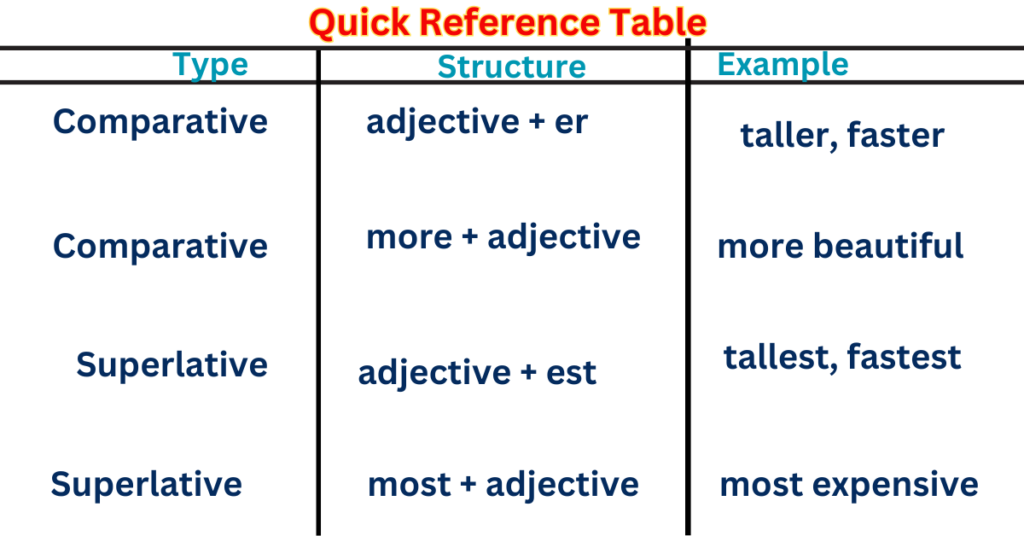
We usually add “-er” to the adjective OR use “more” before the adjective.
Examples:
• tall → taller
• big → bigger
• fast → faster
• beautiful → more beautiful
• comfortable → more comfortable
Use the comparative degree when comparing two things:
• John is taller than Sam.
• This bag is cheaper than the other one.
• My phone is faster than yours.
• The new teacher is more friendly than the old one.
• This sofa is more comfortable than the chair.
What Are Superlative Degrees?
The superlative degree is used to compare three or more people or things. It shows the highest or lowest degree.
We usually add “-est” or use “most”.
Examples:
• tall → tallest
• big → biggest
• fast → fastest
• beautiful → most beautiful
• comfortable → most comfortable
Use superlatives like this:
• John is the tallest boy in the class.
• This is the cheapest restaurant in town.
• She is the most intelligent student.
• That was the most delicious meal I ever had.
• This is the most difficult exam.
4. Rules for Forming Comparative and Superlative Degrees
Let’s make this super easy. I’ll break it down for you:
Rule 1: One-Syllable Adjectives → Add -er / -est
Examples:
| Adjective | Comparative | Superlative |
| tall | taller | tallest |
| small | smaller | smallest |
| cold | colder | coldest |
| fast | faster | fastest |
Sentences:
• A cat is smaller than a dog.
• Mount Everest is the tallest mountain.
• January is colder than March.
Rule 2: One-Syllable Adjectives Ending in CVC → Double the Last Letter
CVC = consonant + vowel + consonant
Examples:
| Adjective | Comparative | Superlative |
| big | bigger | Biggest |
| hot | hotter | Hottest |
| fat | fatter | Fattest |
| sad | sadder | Saddest |
Sentences:
• Summers are hotter than autumn.
• This is the biggest pizza I’ve ever seen!
Rule 3: Adjectives Ending in -y → Change y to i + er / est
Examples:
| Adjective | Comparative | Superlative |
| happy | happier | happiest |
| easy | easier | easiest |
| busy | busier | busiest |
| funny | funnier | funniest |
Sentences:
• My job is easier than yours.
• She is the happiest person today.
Rule 4: Adjectives with 2 or More Syllables → Use “more” / “most”
Examples:
| Adjective | Comparative | Superlative |
| Beautiful | more beautiful | most beautiful |
| Expensive | more expensive | most expensive |
| comfortable | more comfortable | most comfortable |
| Important | more important | most important |
Sentences:
• This smartphone is more expensive than the one you bought.
• She is the most beautiful girl in the room.
Rule 5: Irregular Adjectives (Special Forms)
These do not follow any rule. You must memorize them.
| Adjective | Comparative | Superlative |
| Good | Better | best |
| Bad | Worse | worst |
| Far | farther / further | farthest / furthest |
| Little | Less | least |
| many / much | More | most |
Sentences:
• His English is better than mine.
• This is the worst movie ever.
• She has the least experience in the group.
Useful Examples for Learners
Here are more examples to help you understand comparative and superlative degrees naturally:
Comparative Examples:
• This road is narrower than that one.
• She is more confident now.
• My coffee is hotter than yours.
• Learning English is easier than learning Chinese.
• The blue dress is more stylish than the red one.
Superlative Examples:
• This is the longest river in the country.
• She is the most talented singer.
• This is the least interesting topic.
• That was the best day of my life.
• He is the most hardworking employee.
Common Mistakes Students Make And How You Can Avoid Them
Mistake 1:
She is more taller than him.
She is taller than him.
(Do NOT use both “more” and “-er”.)
Mistake 2:
This is the most easiest question.
This is the easiest question.
Mistake 3:
He is gooder than me.
He is better than me.
Mistake 4:
She is the most tallest girl.
She is the tallest girl.
Fluency Tips: How to Use Comparatives & Superlatives in Daily Speaking
Here are simple tricks beginners use:
Tip 1: Compare Everything Around You
Look around your room and describe items:
Examples:
• My chair is bigger than my stool.
• My bed is the softest place in my room.
• This fan is faster than the old one.
Tip 2: Talk About Food
• Pizza is better than burgers.
• This biryani is the most delicious food ever!
Tip 3: Describe Your Day
Today is busier than yesterday.
• Morning is the best time to study.
Tip 4: Compare People (But Politely!)
• My brother is funnier than me.
• She is the most caring person I know.
Tip 5: Practice With Short Conversations
A: Which phone is better?
B: I think this one is more powerful.
A: Yes, and also the cheapest!
Shortcut Tricks to Learn Them Faster
Trick 1: Think About Sound, Not Spelling
If the word sounds short → use -er / -est
If the word sounds long → use more / most
Trick 2: When Unsure, Use “more”
It is safer to say:
• more modern
• more careful
• more serious
Than to guess.
Trick 3: Learn Irregular Forms Like a Song
good → better → best
bad → worse → worst
little → less → least
many → more → most
Say them daily for 1 minute.
Practice Daily With These Prompts
Try answering these:
• Which subject is more difficult for you?
• Who is the funniest person in your family?
• Which season is better—summer or winter?
• What is the most exciting place you want to visit?
• Which fruit is more delicious?
Speak out loud — your fluency improves when your mouth gets used to English sounds.
Exercises For Practice
EXERCISE 1: Choose the Correct Form
Choose the correct comparative or superlative form.
- This is the __________ route to the airport.
(safe) - Of the three designs, this one looks __________.
(modern) - My new job is __________ than the previous one.
(demanding) - She felt __________ after the long meeting than before.
(tired) - That explanation was __________ I have ever heard.
(clear)
Answers:
- the safest
- the most modern
- more demanding
- more tired
- the clearest
EXERCISE 2: Find & Correct the Mistake
Each sentence has one mistake related to comparison.
Rewrite it correctly.
- This puzzle is the more interesting one in the book.
- She is elder than her cousin by two years.
- Today’s weather is more colder than yesterday’s.
- He is the most confident than anyone else here.
- Of all the options, this plan is better.
Answers:
- This puzzle is the most interesting one in the book.
- She is older than her cousin by two years.
- Today’s weather is colder than yesterday’s.
- He is more confident than anyone else here.
- Of all the options, this plan is the best.
EXERCISE 3: Sentence Transformation
Rewrite the sentence using the word given in brackets without changing the meaning.
- No other city in the country is as polluted as this one.
(most) - This explanation is clearer than the earlier one.
(clear – superlative) - Very few movies are as exciting as this one.
(most) - My brother is not as tall as his best friend.
(shorter) - This is the first time I have faced such a confusing question.
(ever)
Answers:
- This is the most polluted city in the country.
- This explanation is the clearest one.
- This is one of the most exciting movies.
- My brother is shorter than his best friend.
- This is the most confusing question I have ever faced.
Frequently Asked Questions (FAQs)
1. What is the Comparative and Superlative Degree?
The Comparative and Superlative Degree is used to compare adjectives.
- Comparative compares two people, places, or things (taller, faster).
- Superlative compares more than two and shows the highest or lowest degree (tallest, fastest).
2. What is the Comparative and Superlative Degree of adjectives?
The Comparative and Superlative Degree of adjectives shows how the quality of an adjective changes when we compare.
For example:
- tall → taller → tallest
- easy → easier → easiest
These forms help your sentences sound clear and natural.
3. When should I use “-er / -est” and when should I use “more / most”?
Use -er / -est with short adjectives (usually one syllable):
small → smaller → smallest
Use more / most with longer adjectives:
beautiful → more beautiful → most beautiful
This rule is the key to forming correct Comparative and Superlative examples.
4. Can I use “more” with adjectives like “faster”?
No. This is a very common mistake.
You should not say more faster or more better.
Correct forms are:
- fast → faster → fastest
- good → better → best
These are classic Comparative and Superlative Degree of adjectives examples learners should remember.
5. What are irregular Comparative and Superlative adjectives?
Some adjectives do not follow normal rules. These are called irregular adjectives.
Examples:
- good → better → best
- bad → worse → worst
- far → farther/further → farthest/furthest
These must be memorized because they don’t use -er / -est or more / most.
6. How do I compare two things correctly in a sentence?
When comparing two things, always use the comparative form + than.
Example:
This book is more interesting than that one.
Using “than” correctly is essential when practicing Comparative and Superlative Degree of adjectives.
7. Do we always use “the” before superlative adjectives?
Yes, in most cases.
Superlatives usually come with “the” because they point to one extreme.
Example:
She is the smartest student in the class.
This small detail improves grammar accuracy a lot.
8. Why do learners get confused between comparative and superlative forms?
Learners often mix rules, overuse “more,” or forget irregular forms. Another reason is lack of practice. Regular exposure to Comparative and Superlative examples helps remove confusion and build confidence.
9. How can I practice Comparative and Superlative Degree of adjectives effectively?
The best way is through Comparative and Superlative Degree of adjectives exercises.
Try exercises that include:
- Sentence correction
- Fill-in-the-blanks
- Comparison writing tasks
Practice makes these forms automatic and natural in speaking and writing.
Conclusion
And just like that, you’ve reached the end of this friendly guide on comparative and superlative degrees of adjectives .
Give yourself a smile — because you’ve actually learned something very powerful today.
Comparatives and superlatives may look like small grammar points, but they make a huge difference in how natural, clear, and confident your English sounds. Whether you are talking about people, food, places, phones, days, or feelings, these forms help you express opinions, preferences, and comparisons smoothly — just like a real English speaker.
The key thing to remember is this: don’t try to memorize everything at once. Start small. Use comparatives and superlatives in daily life. Compare your day with yesterday. Compare tea with coffee. Compare your old habits with your new ones. The more you use them, the easier they become — almost automatic.
Mistakes? Totally normal. Even native speakers make them sometimes. What matters is that you keep speaking, keep practicing, and keep enjoying the process. English is not about perfection; it’s about communication.
Share your thoughts:
Share in the comments, if your have any query or concern. Don’t forget to subscribe for more such useful content.
I create content to make English learning simple and practical. If you find it helpful, consider supporting me. Your contribution helps me improve my skills and bring better content for you.

It’s perfect time to make some plans for the future and it’s time to be happy. I’ve read this post and if I could I wish to suggest you few interesting things or tips. Perhaps you can write next articles referring to this article. I desire to read even more things about it!
fantastic post.Never knew this, regards for letting me know.