


How to Build Daily English Vocabulary and Speak Confidently Every Day?
Introduction
Daily English Vocabulary is the real secret behind confident English speaking — not complicated grammar rules, not memorizing rare dictionary words, and not copying someone else’s accent. Think about it: every conversation you have during the day depends on simple, practical words. The words you use while ordering tea, answering a phone call, attending a meeting, chatting with friends, or even posting on social media.
But here’s the truth most learners don’t realize…
It’s not about learning more words. It’s about learning the right words — and using them again and again until they become natural.
Why do some people speak English smoothly even with basic vocabulary, while others know hundreds of words but still hesitate? What daily habits make the difference? And how can you train your brain to remember and use new words without feeling overwhelmed?
In this post, you’ll discover a simple, practical system to build your daily English vocabulary step by step. No pressure. No complicated methods. Just clear strategies you can follow every single day.
If you truly want to stop translating in your head and start speaking naturally, keep reading — your transformation starts now.
Why Daily English Vocabulary Is So Important?
Many English learners unknowingly slow down their progress by focusing on complicated, high-level words. They proudly memorize words like phenomenon, nevertheless, and subsequently — yet hesitate when it’s time to say something simple like, “I am tired,” “I am hungry,” or “I need help.”
Here’s the reality: fluency is not built on difficult vocabulary. It is built on daily English vocabulary — the simple, practical words you use in everyday life.
Think about your normal day. You talk about food, work, family, plans, problems, feelings, and small decisions. Nearly 90% of your conversations depend on common, everyday words. When these words become natural to you, speaking becomes automatic. You don’t pause. You don’t translate. You don’t feel nervous.
Confidence grows when your brain can quickly access the words you actually need.
Instead of trying to learn 1,000 rare dictionary words, focus on mastering 300 powerful daily English vocabulary words that you use again and again. When you repeat and apply these words in real conversations, your fluency improves faster than you imagine.
Simple words. Clear thoughts. Confident speech.
That’s the real formula.
Essential Daily English Vocabulary Categories
Let’s break it into practical sections.
1. Greetings & Basic Conversation
These are the most important parts of daily English vocabulary.
Examples:
- Hello
- Hi
- Good morning
- Good evening
- How are you?
- I’m fine.
- I’m good.
- Nice to meet you.
- What’s going on?
- See you later.
Example sentences:
- Hi, how are you today?
- I’m doing well.
- Nice to meet you.
- See you tomorrow.
Practice tip:
Use these every single day. Even at home.
2. Family & Relationships Vocabulary
- Father
- Mother
- Brother
- Sister
- Cousin
- Uncle
- Aunt
- Husband
- Wife
- Neighbour
Example sentences:
- My brother works in Delhi.
- My mother is cooking dinner.
- I live with my parents.
This is practical everyday English words that you must know.
3. Work & Office Vocabulary
For professional daily English vocabulary, you need:
- Job
- Office
- Meeting
- Deadline
- Project
- Boss
- Client
- Salary
- Promotion
- Interview
Example sentences:
- I have a meeting at 10 AM.
- I need to finish this project.
- My boss called me.
Notice something?
These are simple words yet powerful.
4. Shopping & Money Vocabulary
You use this often.
- Price
- Cost
- Cheap
- Expensive
- Discount
- Bill
- Cash
- Online payment
- Refund
- Change
Example:
- How much does this cost?
- It’s too expensive.
- Can I get a discount?
- I’ll pay in cash.
This is real-life spoken English vocabulary.
5. Food & Restaurant Vocabulary
- Breakfast
- Lunch
- Dinner
- Snack
- Menu
- Order
- Water
- Spicy
- Sweet
- Bill
Example:
- I’d like to order tea.
- This food is very spicy.
- Can I have the bill?
6. Travel Vocabulary
- Bus
- Train
- Ticket
- Station
- Airport
- Luggage
- Taxi
- Direction
- Map
- Traffic
Example:
- Where is the bus stop?
- I need a taxi.
- The traffic is heavy.
7. Emotions Vocabulary
To speak naturally, you must express feelings.
- Happy
- Sad
- Angry
- Excited
- Nervous
- Tired
- Worried
- Relaxed
- Confused
- Proud
Example:
- I am tired today.
- I feel nervous.
- I’m very excited.
This is emotional daily English vocabulary — very important for fluency.
How to Remember Daily English Vocabulary Easily
Now listen carefully.
Learning is easy. Remembering is the challenge.
Here are powerful strategies.
1. Use the “3-Time Rule”
When you learn a new word:
- Read it.
- Say it loudly.
- Use it in a sentence.
Example:
Word: “Nervous”
Sentence:
I feel nervous before interviews.
2. Learn in Groups (Not Randomly)
Don’t memorize random words.
Group them:
Money group:
- Cash
- Bill
- Price
- Discount
- Refund
This improves your English vocabulary for beginners quickly.
3. Use “I + Verb” Structure
This is magic.
Start speaking with:
- I want
- I need
- I think
- I feel
- I like
- I don’t understand
Example:
- I need help.
- I want water.
- I think it’s good.
With just this structure, you can use 70% of daily English vocabulary.
4. Mirror Practice
Stand in front of the mirror.
Speak for 2 minutes:
- My name is…
- Today I feel…
- I am going to…
This builds English speaking fluency.
5. Stop Translating Everything
This is very important.
If you think in Hindi first and then translate, you slow down.
Instead, think in small English words:
- I am tired.
- I am hungry.
- I am late.
Small thoughts = faster fluency.
6. Use Vocabulary in Real Life Immediately
Learn today → Use today.
For example:
Learned word: “Excited”
Use it:
- I am excited about this movie.
- I’m excited to meet you.
Immediate usage builds strong daily English vocabulary memory.
How Beginners Can Start Speaking Today
Let me give you a simple formula.
Step 1: Learn 10 words daily
Step 2: Make 10 sentences
Step 3: Speak them loudly
Step 4: Repeat next day
Even if grammar is not perfect, speak.
Fluency comes from speaking, not thinking.
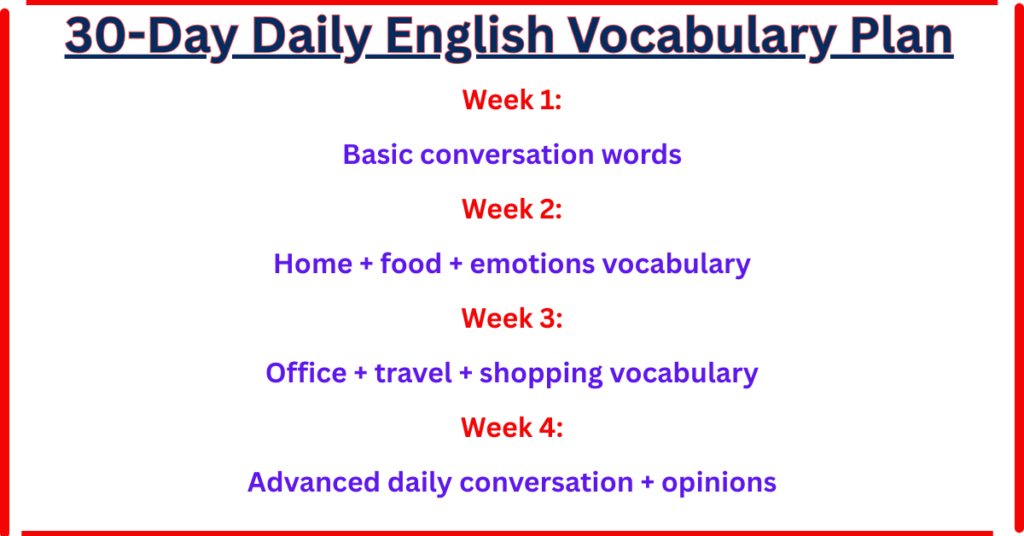
By day 30, your spoken English vocabulary will improve dramatically.
Common Mistakes to Avoid
- Waiting for perfect grammar
- Being afraid of mistakes
- Learning without speaking
- Not revising
- Learning difficult words first
Focus on daily English vocabulary, not difficult dictionary words.
Frequently Asked Questions (FAQs)
1. What is daily English vocabulary?
Daily English vocabulary includes common English words used in daily life for conversations at home, work, and social situations.
2. How can beginners improve daily English vocabulary?
Beginners can improve daily English vocabulary by learning 10 daily use English words per day and using them in sentences.
3. How many words are needed for English speaking fluency?
Around 300–500 strong everyday English words are enough for basic fluency.
4. What are the best English vocabulary building tips?
Use grouping, sentence practice, mirror speaking, and daily revision to improve spoken English vocabulary.
5. Is grammar necessary to improve daily English vocabulary?
Basic grammar helps, but vocabulary and speaking practice are more important for fluency.
6. How can I learn English vocabulary fast?
Use repetition, real-life practice, and daily speaking routines to learn daily use English words faster.
7. What are common English words used in daily life?
Words related to greetings, food, family, work, money, and emotions.
8. How can I improve my basic English vocabulary?
Read simple content, speak daily, and practice 10 words every day.
9. Does reading help to improve English vocabulary?
Yes, reading simple English improves your English vocabulary for beginners level.
10. How long does it take to master daily English vocabulary?
With daily practice, noticeable improvement happens within 30 days.
Conclusion
You don’t need years to gain fluency.
You need:
- 30 minutes daily
- Consistency
- Speaking practice
And remember:
Fluency is not about speed.
It is about comfort.
Start small.
Speak daily.
Use simple words.
Repeat.
Your daily English vocabulary will grow.
Your confidence will grow.
And slowly, English will become natural.
I promise you that.
Share your thoughts:
Now tell me:
Which method of increasing vocabulary will you start using today?
I create content to make English learning simple and practical. If you find it helpful, consider supporting me. Your contribution helps me improve my skills and bring better content for you.