
Introduction
Do you ever learn a new English word, feel happy because you finally understand it, and then completely forget it when you try to speak?
You’re not alone.
Perhaps you have a notebook full of English words. You may have downloaded vocabulary lists, watched English lessons, highlighted new words while reading, or even memorised hundreds of them.
Yet when someone speaks to you in English, you may still struggle to respond.
You know what you want to say, but you can’t find the words quickly enough.
You think:
“I know this word. Why can’t I remember it?“
“I understand English, but why can’t I speak it?”
“Maybe I need to learn more vocabulary.“
Sometimes, learning more words is not the real solution.
The real problem may be that the words you know haven’t become part of your active vocabulary yet.
And that is an important distinction.
You don’t need to spend hours memorising enormous vocabulary lists. Instead, you need a simple system that helps you learn a few useful words, remember them, practise them, and eventually use them naturally.
That’s exactly what we’re going to do in this guide.
If you’re looking for a practical beginner vocabulary daily routine, I’ll show you how to build one without making English learning overwhelming.
You’ll learn how to turn:
New words → sentences → speaking practice → real communication
By the end, you’ll have a simple routine you can use every day, even if you’re just starting to learn English.
Why Learning More Words Doesn’t Always Improve Your Speaking
Let’s begin with a common situation.
Imagine that you learn these five words:
comfortable, decision, improve, probably, opportunity
You memorise their meanings.
You can recognise them when you read them.
You might even answer a vocabulary quiz correctly.
Now someone asks:
“What are your plans for the weekend?”
You hesitate.
You know the question, but you don’t know how to respond quickly.
This happens because recognising a word is different from using a word.
Your brain may have stored the word, but it hasn’t built a strong connection between the word and actual communication.
This is the difference between passive vocabulary and active vocabulary.
Passive vocabulary
These are words you can recognise when you hear or read them.
For example, you may understand:
“This is a wonderful opportunity.”
You know what opportunity means.
Active vocabulary
These are words you can retrieve and use yourself.
For example:
“I had an opportunity to study abroad.”
You didn’t simply recognise the word.
You produced it.
That’s the skill we want to develop.
So when you practise beginner vocabulary daily, don’t ask only:
“How many words did I learn today?”
Ask:
“How many words can I actually use?”
That small change in thinking can completely transform your learning.
What Should a Beginner Do First?
If you’re new to English, you may be tempted to learn difficult vocabulary because it feels like progress.
Imagine learning words such as:
extraordinary, sophisticated, consequently, nevertheless, approximately
while still struggling to say:
“I need some help.”
That isn’t the most efficient way to build communication skills.
As a beginner, your first priority should be basic English vocabulary that you can use repeatedly.
Words such as:
want
need
like
know
think
help
make
take
give
get
go
come
wait
try
are extremely useful because they can appear in hundreds of sentences.
For example:
“I need some help.”
“I need to leave.”
“I need more time.”
“I need to call her.”
One word can open the door to many different sentences.
That’s why effective English vocabulary building is not about collecting impressive words.
It’s about building a useful foundation.
The Golden Rule: Learn Less, Use More
Here’s one of the most important English vocabulary tips I can give you:
Don’t try to learn too many words at once.
If you’re a beginner, start with perhaps five words a day.
Five words may sound small.
That’s the point.
Small enough to remember.
Small enough to practise.
Small enough to use.
Suppose today’s five words are:
need, want, help, wait, call
Instead of immediately learning another twenty words, make sentences.
“I need some water.”
“I want some coffee.”
“Can you help me?”
“Please wait a minute.”
“I’ll call you later.”
Now ask yourself questions:
“What do I need today?”
“What do I want?”
“Who can I help?”
“Who am I waiting for?”
“Who do I need to call?”
Suddenly, those five words are connected to your real life.
That’s much more powerful than memorising five dictionary definitions.
A Simple Beginner Vocabulary Daily Formula
If you want a routine that is easy to follow, use this:
Learn → Understand → Say → Use → Review
Let’s look at each step.
1. Learn
Choose a small number of useful words.
Don’t burden yourself.
Start with five.
2. Understand
Learn what the word means and notice how it is used in a sentence.
For example:
borrow
“Can I borrow your pen?”
Don’t memorise only the definition.
Notice the sentence pattern.
3. Say
Say the word aloud.
Then say the complete sentence.
“Can I borrow your pen?”
Repeat it several times.
4. Use
Create your own sentence.
“Can I borrow your book?”
Then try another:
“I need to borrow your phone.”
5. Review
Come back to the word tomorrow.
Then again after a few days.
This is how daily English practice gradually turns unfamiliar words into familiar ones.
Strategy 1: Learn Words in Sentences
One of the biggest mistakes beginners make is learning vocabulary as isolated items.
For example:
borrow = take and use something belonging to someone else
That’s useful, but not enough.
Instead, learn:
“Can I borrow your pen?”
Now you have a ready-to-use sentence.
Do the same with lend:
“Can you lend me your pen?”
Now you’ve learned two words and two useful sentence patterns.
Try this with forget:
“I forgot my keys.”
With remember:
“I remembered to call her.”
With decide:
“I decided to stay home.”
This method makes English vocabulary with examples much more practical.
Strategy 2: Use the Five-Sentence Method
Here’s one of my favourite vocabulary learning techniques for beginners.
Choose one word.
Then make five sentences.
Let’s take want.
“I want some water.”
“I want to go home.”
“I want a new phone.”
“What do you want?”
“I don’t want anything.”
You’ve now seen the same word in five different situations.
Try it with need:
“I need some help.”
“I need more time.”
“I need to leave.”
“Do you need anything?”
“I don’t need it.”
This method is simple, but it forces your brain to retrieve the word instead of merely recognising it.
And retrieval is exactly what you need when you’re speaking.
Strategy 3: Connect New Words to Your Own Life
Here’s another powerful technique.
Don’t make every sentence about imaginary people.
Make sentences about you.
If you learn busy, say:
“I’m busy today.”
If you learn tired, say:
“I’m tired after work.”
If you learn early, say:
“I wake up early.”
If you learn ready, say:
“I’m ready to leave.”
If you learn excited, say:
“I’m excited about my trip.”
When a word becomes connected to your own experiences, it becomes easier to remember.
So whenever you learn a new word, ask:
“How can I use this word in my own life?”
Strategy 4: Turn Your Routine into an English Lesson
You don’t have to sit at a desk to practise English vocabulary for beginners.
Your everyday life can become your classroom.
Imagine you’re making breakfast.
Instead of doing everything silently, describe what you’re doing:
“I’m making breakfast.”
“I need some bread.”
“The coffee is ready.”
“I’m looking for a spoon.”
“Where are the eggs?”
Now you’re practising vocabulary, grammar and speaking at the same time.
Getting dressed?
“I need my shirt.”
“Where are my shoes?”
“This shirt is clean.”
“I’m ready to leave.”
Cleaning?
“I need to clean the kitchen.”
“The table is dirty.”
“I’ll do it later.”
Driving or travelling?
“The traffic is heavy.”
“I’m almost there.”
“I need to stop here.”
You don’t need a special lesson every time.
Use your ordinary life.
Strategy 5: Talk to Yourself
I know this may sound strange.
If you don’t currently have someone to practise English with, self-talk can be extremely useful.
You can speak quietly or aloud.
For example:
“What am I doing now?”
“I’m making coffee.”
“What do I need?”
“I need my phone.”
“Where is my phone?”
“It’s on the table.”
You’ve just created a tiny conversation.
Do this for one or two minutes.
Don’t worry about sounding silly.
You’re training your brain to retrieve English without waiting for someone else to ask you a question.
This is particularly useful for English speaking for beginners.
Strategy 6: Learn Phrases, Not Just Words
A word becomes much more useful when you know the phrases that naturally go with it.
For example, don’t learn only:
agree
Learn:
“I agree with you.”
Don’t learn only:
sure
Learn:
“Are you sure?”
Don’t learn only:
understand
Learn:
“I don’t understand.”
Don’t learn only:
wait
Learn:
“Please wait a minute.”
Don’t learn only:
idea
Learn:
“That’s a great idea.”
This makes speaking faster because you’re not constructing every sentence word by word.
You’re learning useful language patterns.
Strategy 7: Use the “One Word, Many Situations” Technique
Another useful English vocabulary practice method is to deliberately use the same word in different situations.
Let’s take get.
“I need to get some milk.”
“Did you get my message?”
“I get it now.”
“I need to get ready.”
“It’s getting late.”
You don’t need to master every possible meaning immediately.
You can gradually notice how frequently a common word appears.
This is one reason everyday words are so valuable.
A word such as get may appear in many different conversations.
Strategy 8: Don’t Translate Every Sentence
When you’re a beginner, translation can be useful.
If you translate every single thought before speaking, your English may remain slow and hesitant.
So start creating small direct connections.
See your phone?
Think:
“My phone is on the table.”
Feel hungry?
“I’m hungry.”
Want to leave?
“I want to go home.”
See rain outside?
“It’s raining.”
You don’t need complicated thoughts.
Start with simple ones.
Over time, these direct English thoughts can become faster and more natural.
Strategy 9: Review Before You Learn Something New
Many learners constantly add new vocabulary but rarely review old vocabulary.
That creates a huge list of words they once studied but can no longer remember.
Instead, spend a few minutes reviewing yesterday’s words before learning today’s.
For example:
Yesterday:
want
need
help
wait
call
Today, quickly make sentences:
“I want some water.”
“I need some help.”
“Can you help me?”
“Please wait.”
“I’ll call you later.”
Then learn five new words.
This simple habit can make your beginner vocabulary daily practice much more effective.
Strategy 10: Use Spaced Repetition
You don’t have to review a word fifty times in one day.
Instead, review it at increasing intervals.
For example:
Day 1: Learn it.
Day 2: Review it.
Day 4: Use it again.
Day 7: Test yourself.
Day 14: Use it in speaking.
This gives your brain repeated opportunities to retrieve the word.
And don’t just look at the answer.
Cover the word and ask yourself:
“Can I remember it?”
That small effort matters.
Strategy 11: Don’t Be Afraid of Simple English
Some beginners believe they need long, sophisticated sentences to sound fluent.
They don’t.
Look at these sentences:
“I’m tired.”
“I need some help.”
“I’ll call you later.”
“I don’t know.”
“I don’t understand.”
“Can you repeat that?”
These are short.
Yet they are extremely useful.
Your goal at the beginning isn’t to impress people with complicated vocabulary.
Your goal is to communicate clearly.
Simple English is a strong foundation.
Once simple sentences become automatic, you can gradually make them longer.
For example:
Simple:
“I’m tired.”
A little longer:
“I’m very tired today.”
More natural:
“I’m very tired today because I didn’t sleep well last night.”
That’s how your speaking grows.
Strategy 12: Learn What to Say When You Forget a Word
Here’s a secret that can make you a more confident speaker:
You don’t need to know every word to keep a conversation going.
Sometimes you’ll forget a word.
That’s normal.
Instead of stopping completely, use phrases such as:
“Let me think.”
“How do I say this?”
“I don’t know the exact word.”
“What I mean is…”
“Let me explain.”
For example, imagine you’ve forgotten the word umbrella.
You could say:
“I forgot the word, but it’s something you use when it rains.”
You’ve communicated your meaning.
That’s a speaking skill in itself.
Strategy 13: Record Your Voice
Here’s a simple English speaking practice exercise.
Choose five words you’ve learned.
Set a timer for one minute.
Talk about your day.
For example:
“I woke up early today. I was a little tired, but I had coffee and got ready for work. I was busy in the morning. In the evening, I want to relax and watch a movie.”
Now listen to your recording.
Don’t criticise every mistake.
Instead, notice:
- Which words did I remember?
- Where did I hesitate?
- Which words were difficult to use?
- Did I speak in complete sentences?
- What can I improve tomorrow?
Repeat the exercise a few days later.
You may notice that words that once required effort begin to come naturally.
Strategy 14: Use Vocabulary in Real Conversations
Eventually, vocabulary needs to leave your notebook.
Use it.
If you’ve learned:
busy
say:
“I’m busy right now.”
If you’ve learned:
free
ask:
“Are you free this evening?”
If you’ve learned:
plan
ask:
“What’s your plan for tomorrow?”
If you’ve learned:
remember
say:
“Remember to call me.”
Real communication is where vocabulary becomes truly useful.
That’s why your daily English vocabulary routine should always include some speaking.
A 15-Minute Beginner Vocabulary Daily Routine
If you’re wondering how to fit all of this into a busy schedule, don’t worry.
You don’t need hours.
Try this 15-minute daily English practice routine.
Minutes 1–3: Review
Review yesterday’s five words.
Try to remember them without looking.
Minutes 4–7: Learn
Choose five new words.
Write one useful example for each.
Minutes 8–10: Speak
Say the words and sentences aloud.
Minutes 11–13: Create
Make your own sentences.
Try to connect them to your life.
Minutes 14–15: Talk
Speak for one minute using as many of today’s words as possible.
That’s it.
Fifteen focused minutes.
The secret is consistency.
Your 7-Day Vocabulary Building Plan
If you’re ready to start, here’s a simple first week.
Day 1: Your Routine
Learn vocabulary related to waking up, eating, getting ready and leaving home.
Speak about your morning.
Day 2: Your Home
Describe rooms, objects and activities around your home.
“The window is open.”
“The book is on the table.”
Day 3: People
Talk about your family, friends, colleagues or classmates.
“My friend is very helpful.”
Day 4: Food
Talk about what you eat and drink.
“I usually have coffee in the morning.”
Day 5: Work or Study
Describe what you do during the day.
“I start work at nine.”
Day 6: Feelings
Talk about how you feel.
“I’m tired today.”
“I’m excited about the weekend.”
Day 7: Review
Don’t learn lots of new words.
Review everything you’ve learned.
Then speak for two or three minutes.
Tell yourself what you did during the week.
How Many Words Should You Learn Every Day?
There is no magic number.
Some learners can comfortably learn ten words.
Others may find five more manageable.
And that’s perfectly fine.
If you’re a complete beginner, I’d rather see you learn five words and actually use them than memorise thirty words and forget most of them.
Think about it this way.
Five words a day for a month gives you approximately 150 learning opportunities.
The real value is not the number 150.
It’s the sentences you create and the conversations you have with those words.
Therefore, don’t turn vocabulary learning into a competition.
Consistency matters more than speed.
What If You Forget a Word?
You will forget words.
That’s normal.
Please don’t see forgetting as failure.
Forgetting simply tells you:
“I need more exposure to this word.”
Review it.
Use it.
Hear it.
Write it.
Say it.
Then encounter it again.
You may forget the word several times before it becomes automatic.
That’s part of learning.
The goal isn’t:
Never forget anything.
The goal is:
Remember a little more each time you practise.
How to Know Whether a Word Has Become Part of Your Active Vocabulary
Here’s a simple test.
Take a word you’ve studied.
For example:
improve
Can you complete these sentences quickly?
“I want to ______ my English.”
“I need to ______ my pronunciation.”
“How can I ______ my speaking skills?”
If you can use the word without stopping to translate, that’s a good sign that it is becoming part of your active vocabulary.
You can create your own test for every new word.
Ask:
Can I recognise it?
Can I explain it?
Can I make a sentence?
Can I say it without looking?
Can I use it naturally?
The final two questions are especially important for speaking.
Don’t Try to Learn Everything
English has a huge vocabulary.
You don’t need all of it.
Even advanced speakers don’t use every English word they know.
As a beginner, focus on words that are:
- useful
- common
- relevant to your life
- easy to practise
- useful in conversation
Then gradually expand.
Your vocabulary should grow alongside your life and communication needs.
If you start travelling, learn travel vocabulary.
If you start working in an English-speaking environment, learn workplace vocabulary.
If you’re preparing for an exam, learn the vocabulary relevant to that exam.
If you’re trying to improve everyday conversation, focus on everyday language.
That’s a much smarter approach to how to learn English vocabulary.
Your Vocabulary Notebook Can Be Simple
You don’t need a complicated vocabulary system.
Create four columns:
| Word | Example | My Sentence | Reviewed |
| need | I need some help. | I need more time. | ✓ |
| borrow | Can I borrow your pen? | Can I borrow your book? | ✓ |
| busy | I’m busy today. | I’m busy this morning. | ✓ |
The important column is My Sentence. That’s where passive knowledge starts becoming active knowledge.
The Real Goal of Vocabulary Learning
Let’s go back to the problem we discussed at the beginning.
You may have experienced this:
You recognise a word.
You understand it but you can’t use it.
The solution isn’t simply to memorise more words.
You need to create a bridge between recognition and communication.
That bridge is practice.
See the word.
↓
Understand it.
↓
Hear it.
↓
Say it.
↓
Use it in a sentence.
↓
Use it in your real life.
↓
Review it.
↓
Use it again.
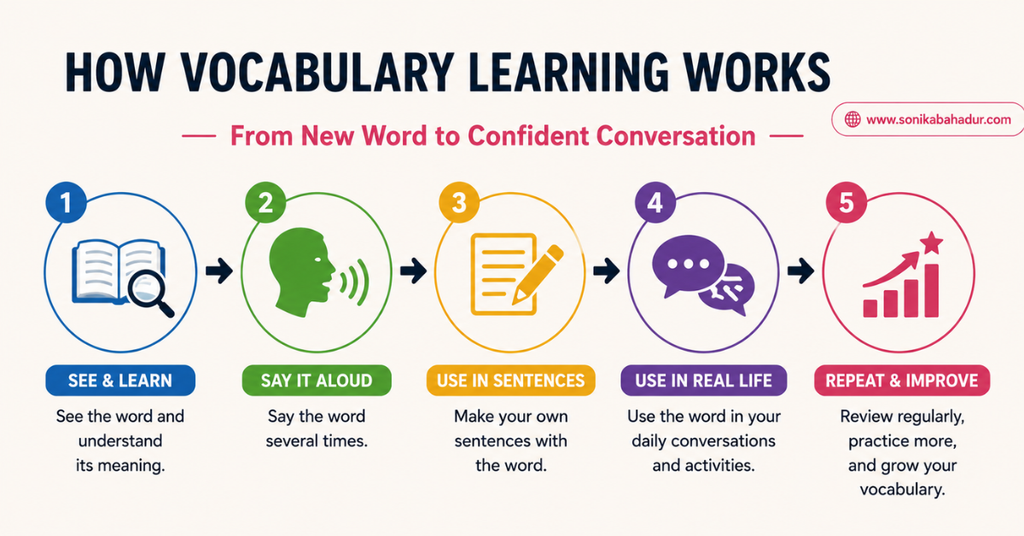
This is how vocabulary gradually becomes available when you need it.
Your Beginner Vocabulary Daily Checklist
If you want something extremely simple to follow, save this checklist.
Every day:
Review yesterday’s words.
Learn 5 useful new words.
Learn each word in a sentence.
Say each sentence aloud.
Create your own sentence.
Use the words in a short speaking exercise.
Review them again later.
That’s your beginner vocabulary daily system.
You don’t need to make it more complicated.
What Should You Do After Learning the Basics?
Once you’re comfortable with basic vocabulary, start increasing the difficulty gradually.
Move from:
words → phrases → sentences → short conversations → longer conversations
For example:
Word
plan
Phrase
my plan
Sentence
“I have a plan.”
Question
“What’s your plan?”
Conversation
A: What’s your plan for tomorrow?
B: I have a meeting in the morning, and then I want to visit my friend.
A: Sounds good. What time will you be free?
This is how vocabulary connects with actual speaking.
If you also want a ready-made collection of useful words and expressions for everyday conversations, you can pair this learning method with a dedicated daily English vocabulary resource.
The two purposes are different:
Learn useful vocabulary → then learn how to make that vocabulary active.
Frequently Asked Questions
1. How can I improve my English vocabulary as a beginner?
The best way to improve English vocabulary is to learn a small number of useful words and practise using them in sentences. Read, listen, speak and review regularly instead of relying only on memorisation.
2. How many English words should I learn every day?
For many beginners, five to ten words a day is a manageable starting point. However, quality matters more than quantity. You should be able to remember and use the words rather than simply recognise them.
3. What is the best way to learn English vocabulary?
One of the most effective approaches is to learn words in context. Learn the word, understand its meaning, study an example, create your own sentence, say it aloud and use it again later.
4. How can I remember English words easily?
Use repetition and personal examples. Connect new words to your own life and review them at spaced intervals. Making your own sentences can also help move words from passive vocabulary to active vocabulary.
5. Why do I understand English but can’t speak it?
You may have good passive vocabulary but limited active vocabulary. You recognise English when you hear or read it, but you haven’t practised retrieving the words quickly while speaking.
The solution is more active English speaking practice.
6. How can I practise English vocabulary at home?
You can practise at home by describing your activities in English, talking to yourself, reading aloud, making sentences with new words and recording yourself speaking.
7. Should beginners learn difficult English words?
Not necessarily. Beginners should first focus on basic English vocabulary that is useful in everyday communication. Once common vocabulary becomes comfortable, gradually add more advanced words.
8. How can I start speaking English as a beginner?
Start with short sentences about yourself and your daily life.
“I’m tired.”
“I need some water.”
“I’m going to work.”
“I like this.”
“I’ll call you later.”
Then gradually combine simple sentences into longer conversations.
9. How long does it take to build English vocabulary?
Vocabulary develops gradually through exposure and practice. You may notice improvement relatively quickly when you practise consistently, but building a strong working vocabulary takes continued reading, listening, speaking and review.
10. Can I learn English vocabulary without a speaking partner?
Yes. A speaking partner can be helpful, but you can begin with self-talk, reading aloud, voice recordings and speaking prompts. These activities allow you to practise retrieving vocabulary before using it in conversations with other people.
11. What is the difference between active and passive vocabulary?
Passive vocabulary consists of words you can recognise when reading or listening. Active vocabulary consists of words you can retrieve and use yourself while speaking or writing. Effective vocabulary practice gradually moves words from passive to active use.
12. How can I make my English vocabulary more useful?
Learn words that relate to your real life and learn them in phrases and sentences. Then deliberately use them during everyday activities and conversations.
13. Is learning five English words a day enough?
Five words a day can be a very good starting point for a beginner if you actively practise them. The goal isn’t simply to increase the number of words you know. The goal is to increase the number of words you can actually use.
14. What should I do when I forget an English word while speaking?
Don’t stop the conversation completely. Try describing the word or explaining what you mean. You can also use phrases such as:
“I don’t know the exact word.”
“Let me explain.”
“What I mean is…”
This helps you keep communicating while you continue building vocabulary.
Conclusion
If you’ve ever felt frustrated because you know English words but can’t speak confidently, please don’t give up.
Your problem may not be that you’re incapable of learning English.
You may simply need a better way to practise.
Don’t try to learn fifty words today.
Learn five.
Don’t just read them.
Say them.
Don’t just memorise their meanings.
Put them into sentences.
Don’t keep your sentences inside a notebook.
Use them to talk about your real life.
And don’t worry if you make mistakes.
Every sentence you speak is practice.
Every forgotten word is an opportunity to review.
Every small conversation is another step forward.
If you make beginner vocabulary daily practice a habit, your progress may feel slow at first.
Then, gradually, something wonderful happens.
Words that once felt unfamiliar begin to feel familiar.
Sentences become easier.
You hesitate less.
You start remembering phrases without translating them.
You begin responding more quickly.
And eventually, English starts feeling less like a subject you’re studying and more like a language you’re actually using.
Therefore, start small.
Five words. Fifteen minutes. Every day.
Learn.
Use.
Review.
Speak.
Then do it again tomorrow because fluency isn’t built in one giant leap.
It’s built through small pieces of English used consistently—one word, one sentence and one conversation at a time.
Share your thoughts
Share in the comments, if your have any query or concern. Don’t forget to subscribe for more such useful content.
I create content to make English learning simple and practical. If you find it helpful, consider supporting me. Your contribution helps me improve my skills and bring better content for you.