Best English Speaking Apps to Practice English Conversation and Speak With Confidence
Introduction
Have you been learning English for months—or perhaps even years—but still struggle when it is time to speak? You understand English. You know many words. You have studied grammar. You can probably read this article without much difficulty but then someone suddenly asks you a simple question in English:
“What did you do this weekend?”
And your mind goes blank.
You know what you want to say. You could answer easily in your own language but in English, you start searching for words, translating sentences in your head, worrying about grammar and wondering whether your pronunciation sounds right.
Finally, you give a tiny answer:
“Nothing much.”
And later, you think of ten better sentences you could have said!
If this happens to you, stay with me because your problem may not be that you need to learn more English, you may simply need to speak more English.
And that is exactly what I am going to help you do.
In this guide, we’ll look at some of the best English speaking apps and best apps to practice English conversation. More importantly, however, I will show you how to actually use them to build fluency.
Even if you are a complete beginner.
Even if nobody around you speaks English.
Even if you feel nervous speaking to strangers.
Even if you can currently speak only two or three sentences at a time.
By the end of this article, you will have a simple system for English speaking practice for beginners that you can start today.
Why Can You Understand English but Not Speak It?
This is one of the most common problems English learners face.
And there is a simple reason for it.
Understanding English is not the same as producing English.
You might watch English videos, read English articles and complete grammar exercises every day. All of these activities help you learn.
Speaking requires another skill: your brain has to find the right words and turn them into sentences quickly.
Suppose someone asks:
“What are you doing tomorrow?”
You might immediately start thinking:
Tomorrow… future tense… should I use “will” or “going to”? What is the English word for…?
That mental process makes conversation exhausting.
Now imagine being able to answer automatically:
“I’m going shopping tomorrow.”
Or:
“I’m meeting a friend after work.”
Or:
“I don’t have any plans yet. I’ll probably stay home.”
That is what we want.
The goal is not to know every English word.
The goal is to make the English you already know easier to use.
Why Studying More Grammar May Not Solve Your Speaking Problem
Many learners respond to poor speaking confidence by studying even more.
They learn another tense.
Then another grammar rule.
Then another list of vocabulary.
Yet when someone says:
They still freeze. Why?
It is because speaking is a practical skill.
Imagine trying to learn swimming by reading books about swimming.
You could learn everything about breathing, body position and swimming techniques.
To swim, you have to get into the water.
English works in a similar way.
At some point, you have to open your mouth and speak.
This is where the best English speaking apps can become useful. They give you more opportunities to hear English, repeat sentences, practise pronunciation and, depending on the app, communicate with other people.
However, there is an important warning.
Downloading an English Speaking App Will Not Make You Fluent
I don’t want you to download seven apps after reading this article.
In fact, that can make things worse.
Monday: you use one app.
Tuesday: you try another.
Wednesday: someone recommends a third.
Two weeks later, your phone is full of English conversation practice apps, but you still haven’t spoken English for more than five minutes.
Remember this:
Don’t collect apps. Collect speaking minutes.
The best English speaking apps are tools.
Your daily practice creates fluency.
One app used consistently for three months can be far more useful than five apps you use occasionally.
What Should You Look for in the Best English Speaking Apps?
Before choosing an app, ask yourself:
“What is stopping me from speaking English?”
Different learners have different problems.
If you don’t know enough basic words and sentence structures, you need structured learning.
If you know English but are afraid of your pronunciation, you need pronunciation practice.
If you can speak alone but become nervous with people, you need real conversation.
Therefore, don’t simply ask:
“What is the best app?”
Ask:
“What is the best app for MY speaking problem?”
Look for features such as:
- opportunities to speak aloud
- pronunciation feedback
- useful everyday vocabulary
- real-life conversation topics
- beginner-friendly lessons
- repetition
- voice or audio features
- opportunities to communicate with real people
Now let’s look at some of the best apps to practice English speaking.
1. Duolingo — Good for Beginners Building the Basics
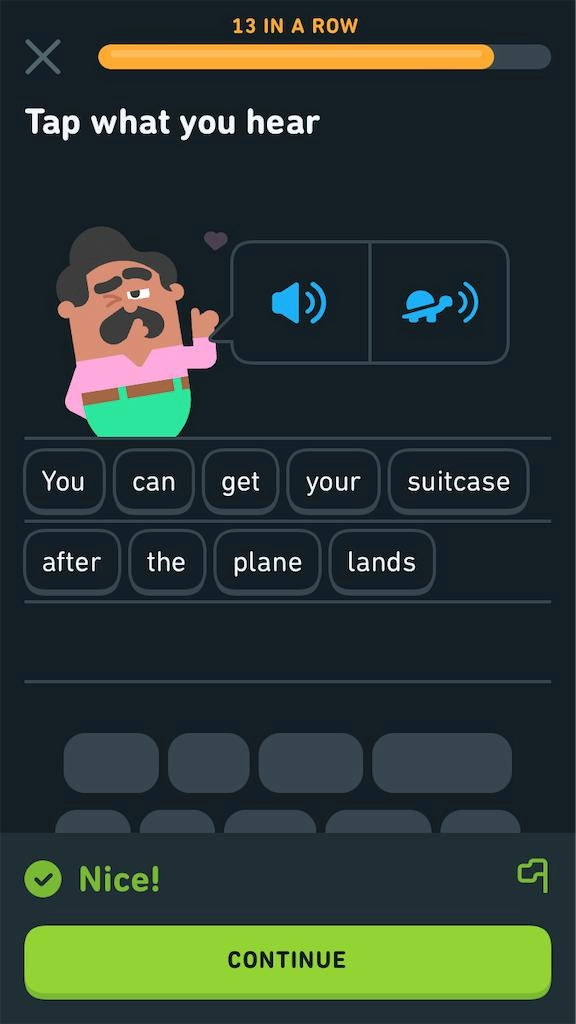
Duolingo is one of the world’s best-known language-learning platforms.
For beginners, its biggest advantage is its structure.
You can gradually learn vocabulary and sentences connected with everyday topics such as food, family, work, travel and daily activities.
However, here’s the trick:
Don’t practise silently.
If you see:
“I drink coffee every morning.”
Say it aloud.
Then change it:
“I drink tea every morning.”
Then personalise it:
“I usually drink tea in the morning, but sometimes I have coffee.”
Now one app exercise has become a mini speaking lesson.
This is how you should use the best English speaking apps: don’t only complete exercises—turn them into conversation.
2. ELSA Speak — Good for Pronunciation and Speaking Confidence
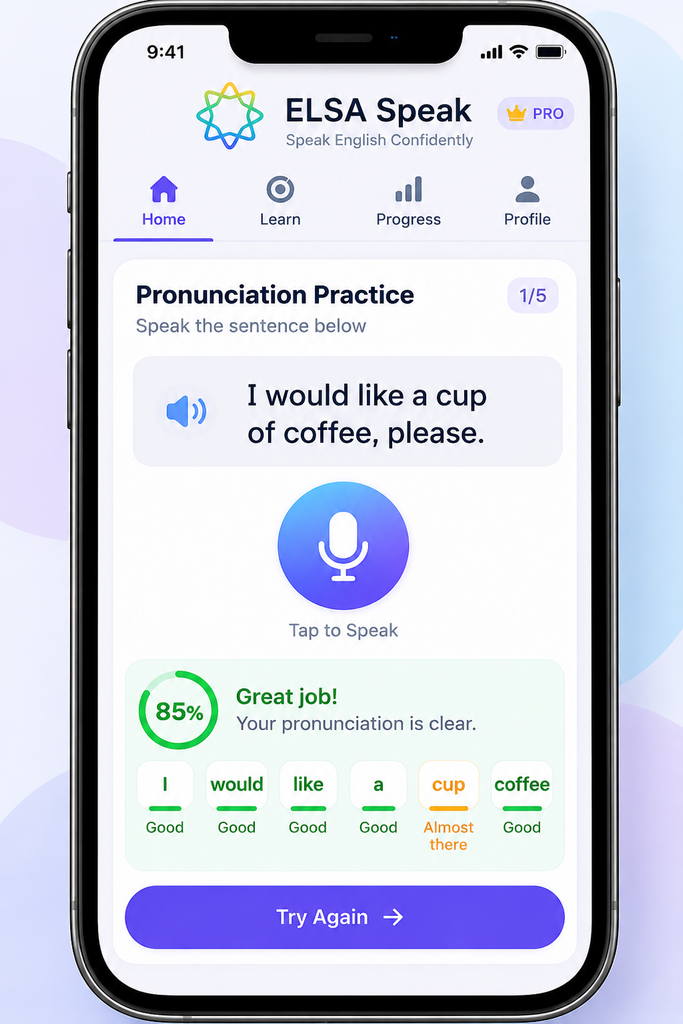
If you know what you want to say but worry that people won’t understand your pronunciation, ELSA Speak can be useful.
It focuses strongly on pronunciation and spoken English.
For example, you can practise sentences such as:
“Could you please help me?”
“I’d like a cup of coffee.”
“What time does the meeting start?”
Please remember something important:
You do not need a perfect native accent to speak good English.
English is spoken by people all over the world.
Your goal should be:
clear + understandable + confident
—not perfect.
Therefore, if pronunciation anxiety is preventing you from speaking, use a pronunciation-focused English speaking practice app to build confidence, but don’t spend months trying to make every sound perfect before having a conversation.
3. HelloTalk — Good for Real English Conversation Practice
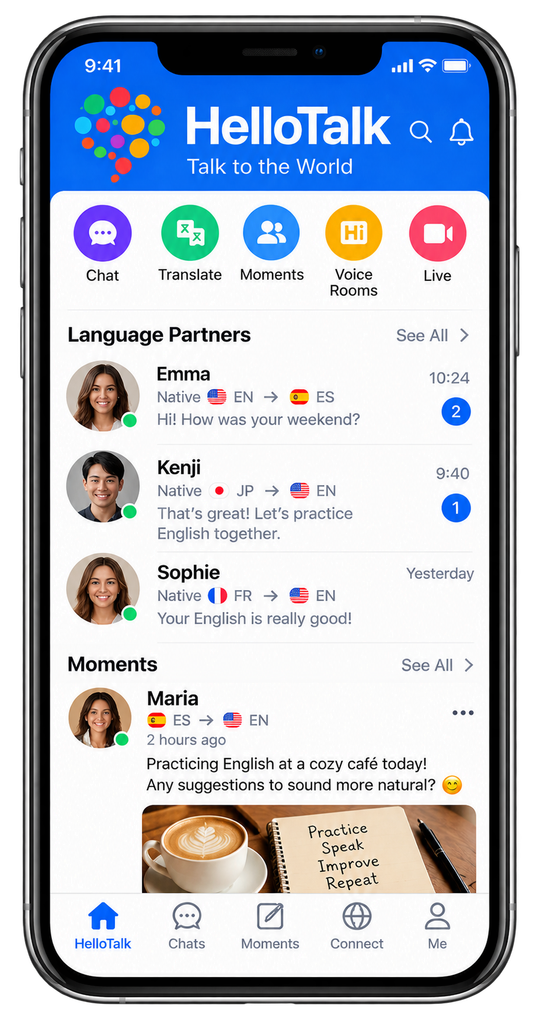
Eventually, English needs to leave your textbook and enter a real conversation.
HelloTalk connects language learners and speakers around the world, which makes it useful for people who want to practice English speaking online with others.
You don’t need to begin with a 30-minute conversation.
Start small.
“Hi! Where are you from?”
Then:
“What do you do?”
Then:
“What do you like doing in your free time?”
Then:
“I’m learning English. How long have you been learning languages?”
That’s a conversation!
It doesn’t need to be complicated.
If you’re nervous, begin with text or other available communication features and gradually move toward more speaking practice as you become comfortable.
4. Tandem — Good for Language Exchange
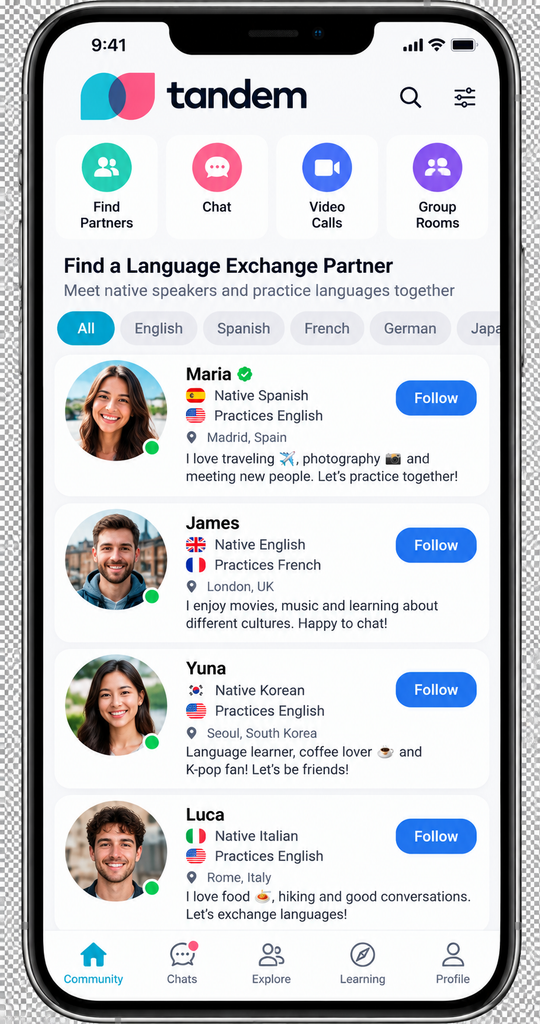
Tandem is another language-exchange platform with members across many countries.
It can be useful when you are ready to move from practising sentences alone to communicating with another person.
One important strategy is to prepare your topic beforehand.
For example, today’s topic could be:
FOOD
Prepare five questions:
“What’s your favourite food?”
“Do you enjoy cooking?”
“What food is popular in your country?”
“Do you prefer eating at home or eating out?”
“What’s something you would like to learn to cook?”
Now you don’t need to panic about what to say.
You already have a conversation plan.
This tiny trick can make English conversation practice for beginners much less frightening.
Which English Speaking App Should You Choose?
Here is the simplest way to decide:
| Your main problem | App to consider |
| “I’m a complete beginner.” | Duolingo |
| “I’m worried about pronunciation.” | ELSA Speak |
| “I want to talk to people.” | HelloTalk |
| “I want language exchange.” | Tandem |
You do not necessarily need all four.
Choose the app that solves your biggest current problem.
Then use the strategies below to turn that app into a complete speaking routine.
How to Practice Speaking English at Home — Even If You’re a Beginner
Now we reach the most important part.
An app can give you material.
You have to create the speaking habit.
And you can begin without another person.
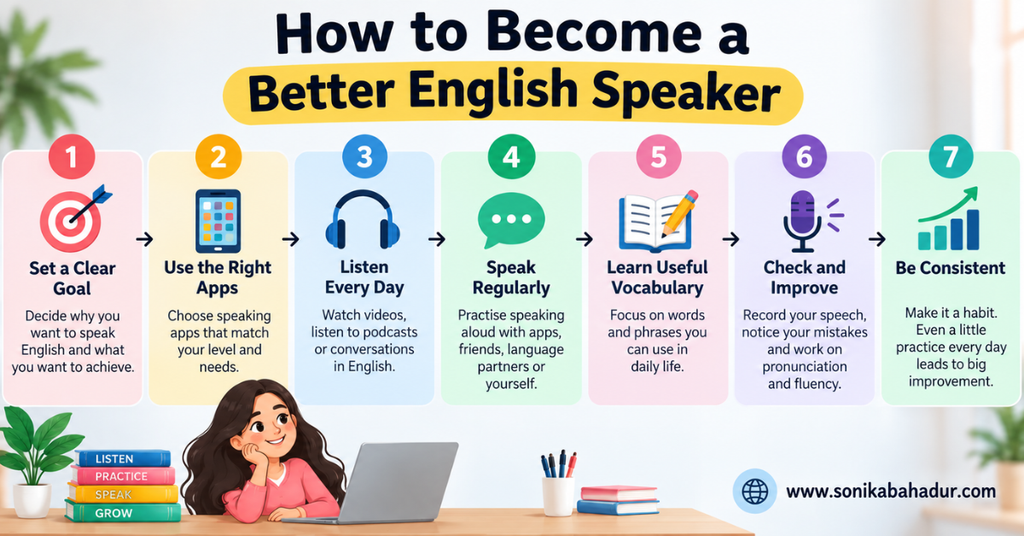
Strategy 1: Talk to Yourself
Yes, really.
Self-talk is one of the easiest forms of English speaking practice for beginners because there is no pressure.
Describe what you are doing.
When you wake up:
“I’m still tired.”
“I need to get up.”
“I have a busy day today.”
While making breakfast:
“I’m making breakfast.”
“I need some milk.”
“Where is the sugar?”
While getting ready:
“I’m running late.”
“I can’t find my keys.”
“I need to leave in ten minutes.”
This is real English for real life.
Strategy 2: Use the 10-Minute Speaking Rule
You don’t need to practise for an hour.
Start with ten minutes.
Minutes 1–3: Describe your surroundings
“I’m sitting in my room.”
“There is a window beside me.”
“My phone is on the table.”
Minutes 4–6: Talk about your day
“I woke up at seven.”
“I had a busy morning.”
“I went shopping in the afternoon.”
Minutes 7–8: Talk about tomorrow
“Tomorrow I need to…”
“I’m planning to…”
“I hope I can…”
Minutes 9–10: Speak freely
Choose one topic and keep talking.
Don’t stop because of a mistake.
Keep going.
Strategy 3: Stop Learning Single Words
Suppose you learn the word:
prefer
Don’t simply memorise:
prefer = like something more
Learn a sentence pattern:
“I prefer ___ because ___.”
Now practise:
“I prefer tea because I don’t really like coffee.”
“I prefer working in the morning because I have more energy.”
“I prefer travelling by train because I find it relaxing.”
You have turned one word into a speaking tool.
This is one of the fastest ways to improve English speaking skills.
Strategy 4: Learn English in Chunks
Fluent speakers don’t create every sentence one word at a time.
They use familiar groups of words.
Learn chunks such as:
“I’m not sure.”
“It depends.”
“To be honest…”
“I don’t think so.”
“That sounds good.”
“Give me a minute.”
“What do you mean?”
“Could you say that again?”
“As far as I know…”
When these chunks become automatic, conversations become easier.
Strategy 5: Use the Question + Answer + Reason Method
This is one of my favourite speaking exercises.
Question:
“Do you like travelling?”
Beginner answer:
“Yes.”
Better:
“Yes, I like travelling.”
Better again:
“Yes, I like travelling because I enjoy visiting new places.”
Even better:
“Yes, I love travelling because I enjoy visiting new places and learning about different cultures.”
Use this formula:
Answer + Reason + Example
For almost any question.
Strategy 6: Try the 30-Second → 1-Minute → 2-Minute Method
Choose one easy topic.
For example:
My family
Speak for 30 seconds.
Then speak about the same topic for one minute.
Then try two minutes.
You’ll naturally begin adding details.
Next day choose:
My job
Then:
My favourite food
Then:
My hometown
Then:
My weekend
Then:
A place I want to visit
This is much more effective than waiting until you “feel fluent.”
Strategy 7: Record Yourself Speaking
Your phone can become one of your best English fluency apps without downloading anything.
Choose a question:
“What did I do today?”
Record a one-minute answer.
Listen once.
Don’t look for twenty mistakes.
Find one thing to improve.
Maybe you pause too often.
Maybe you keep saying “umm.”
Maybe you use the same word repeatedly.
Maybe one word is difficult to pronounce.
Fix one thing.
Record yourself again next week.
Over time, those recordings become proof of your progress.
How to Stop Translating in Your Head
If you’re constantly translating, don’t force yourself to suddenly “think completely in English.”
That’s too difficult for many beginners.
Start with tiny thoughts.
When you’re hungry:
“I’m hungry.”
When you’re tired:
“I’m tired.”
When you can’t find something:
“Where is it?”
Before leaving home:
“I need my phone.”
When you’re busy:
“I’ll do it later.”
When you don’t understand:
“I don’t understand.”
Your brain gradually begins connecting the situation directly with English.
That is how you reduce translation.
Your 7-Day English Speaking Challenge
Want to begin immediately?
Try this.
Day 1 — Introduce yourself
Speak for one minute about yourself.
Day 2 — Your daily routine
Use:
“I usually…”
“Then I…”
“After that…”
Day 3 — Your family or friends
Describe people you know.
Day 4 — Your favourite food
Explain what you like and why.
Day 5 — Your last weekend
Practise talking about the past.
Day 6 — Your future plans
Use:
“I’m going to…”
“I’m planning to…”
“I’d like to…”
Day 7 — Have a conversation
Use one of the English conversation practice apps, practise with a friend, or ask and answer questions yourself.
Your target isn’t perfect grammar.
Your target is:
MORE SPEAKING.
The Daily Formula That Can Change Your English
Here is the system I want you to remember:
LISTEN → REPEAT → PERSONALISE → SPEAK → REPEAT
Suppose your app teaches:
“I’m looking for a restaurant.”
Repeat it.
Then personalise it:
“I’m looking for my phone.”
“I’m looking for a new apartment.”
“I’m looking for a good book.”
Then use the same pattern tomorrow.
This is how you turn passive English into active English.
What If You Make Mistakes While Speaking?
You will.
And that’s fine.
Imagine you say:
“Yesterday I go to the market.”
You realise your mistake.
Correct it:
“Yesterday I went to the market.”
Repeat the correct sentence once.
Then continue speaking.
Don’t turn every mistake into a five-minute grammar lesson.
If you stop after every mistake, your brain learns:
Speaking English = stress.
Instead, teach your brain:
Speaking English = communication.
Accuracy will improve with practice.
What Are the Best English Speaking Apps?
The best English speaking apps depend on what you need right now.
Duolingo can help beginners build basic vocabulary and sentence familiarity.
ELSA Speak can help learners who want more pronunciation-focused practice.
HelloTalk and Tandem can help you move toward communication with real people around the world.
These platforms have international audiences, although specific features, pricing and availability may vary by country or region.
Remember:
The app isn’t the final solution.
Speaking is.
Use the app.
Learn a sentence.
Close the app.
Say the sentence.
Change the sentence.
Use it in your life.
Record yourself saying it.
Use it in a conversation.
That is how an English speaking practice app becomes a fluency tool.
Frequently Asked Questions
1. What are the best English speaking apps for beginners?
Popular options include Duolingo for structured beginner learning, ELSA Speak for pronunciation practice, and HelloTalk or Tandem for interaction with other language learners. The right choice depends on whether you need basic English, pronunciation help or real English conversation practice.
2. What are the best apps to practice English conversation?
HelloTalk and Tandem are useful options for learners who want to communicate with other people. Learners who are not yet comfortable speaking to strangers can begin with pronunciation practice, self-talk and structured learning before gradually moving into real conversations.
3. How can I practice English speaking online for free?
You can use free features available on language-learning or language-exchange apps, practise with language partners, record your voice, use online videos for shadowing and talk to yourself in English. Free features and limits can change, so check the current options available in your country.
4. How can I practice speaking English at home?
Talk about your daily activities aloud, answer simple questions, record yourself, read dialogues aloud and describe objects around you. Even 10 minutes of English speaking practice daily can help you build a consistent speaking habit.
5. Which English speaking practice app is best for pronunciation?
A pronunciation-focused app such as ELSA Speak may be useful if pronunciation is your main concern. However, remember that clear and understandable speech is more important than trying to develop a “perfect” accent.
6. How can beginners improve their English speaking?
Start with short sentences about familiar topics. Practise everyday sentence patterns, talk to yourself, repeat useful phrases, answer simple questions and gradually increase how long you speak. This makes English speaking practice for beginners much less overwhelming.
7. How do I stop translating English in my head?
Begin thinking in short English chunks such as “I’m tired,” “I need this,” “I’ll do it later,” and “I’m not sure.” As these expressions become automatic, your brain gradually learns to connect thoughts directly with English.
8. Can I learn to speak English without a speaking partner?
Yes. Self-talk, voice recording, shadowing, reading aloud and speaking exercises can all help you improve English speaking skills before you start practising with another person.
9. How much English speaking practice should I do every day?
Start with 10–15 minutes. Daily practice is generally more useful for building a habit than doing one very long session occasionally. As speaking becomes easier, gradually increase the amount of time you spend using English.
10. How can I speak English fluently and confidently?
Focus on frequent speaking rather than waiting for perfect grammar. Learn useful phrases and sentence patterns, repeat them in different situations, practise speaking about familiar topics and gradually start having real conversations. Fluency develops through repeated use.
Conclusion
I want to leave you with this because it matters.
Please don’t wait until you feel confident before speaking.
Speak to build confidence.
Don’t wait until you know enough vocabulary.
Use the vocabulary you already know.
Don’t wait until your grammar is perfect.
Speak, notice your mistakes and improve gradually.
And please don’t compare yourself with somebody who has been speaking English for ten years.
Compare yourself with yourself.
Maybe today you can speak for 30 seconds.
Next month, perhaps it will be three minutes.
One day, someone may ask:
“What did you do this weekend?”
And instead of translating, checking grammar and panicking, you’ll simply answer:
“It was actually a really nice weekend. I went out with some friends on Saturday, and on Sunday I stayed home and relaxed.”
And you may not even notice what happened.
You just spoke English.
So choose one of the best apps to practice English conversation and start today.
Not next Monday.
Not when your grammar improves.
Today.
Open the app.
Learn something useful.
Then put the phone down and say it aloud.
It is because the road to fluent English doesn’t begin with a perfect sentence.
It begins with your next sentence.
I create content to make English learning simple and practical. If you find it helpful, consider supporting me. Your contribution helps me improve my skills and bring better content for you.