Introduction
Have you ever introduced yourself to someone in English, exchanged smiles, said “Nice to meet you,” and then suddenly gone completely blank? You know you should say something more, but your mind refuses to help! A few seconds pass, the other person looks at you, and an awkward silence begins.
If this sounds familiar, you’re not alone. Many English learners know how to greet someone and introduce themselves, but they struggle with the next sentence. They can say “Hello,” “How are you?” and “Nice to meet you,” but they don’t know how to keep the conversation going.
Here’s something I want you to remember: You don’t need complicated English or impressive vocabulary to continue a conversation. You just need a few natural follow-up questions and the confidence to use them.
In this guide, I’ll show you exactly what to say after nice to meet you, how to choose the right sentence for different situations, and how to avoid those uncomfortable pauses. You’ll also learn practical conversation tricks and speaking exercises that you can start using today.
Let’s make your next English conversation much easier!
1. What to Say After “Nice to Meet You”: 10 Natural Responses
First, let’s look at some simple sentences you can use immediately after exchanging greetings.
You don’t always need to ask a question. Sometimes, a friendly comment or a little information about yourself is enough to keep the conversation moving.
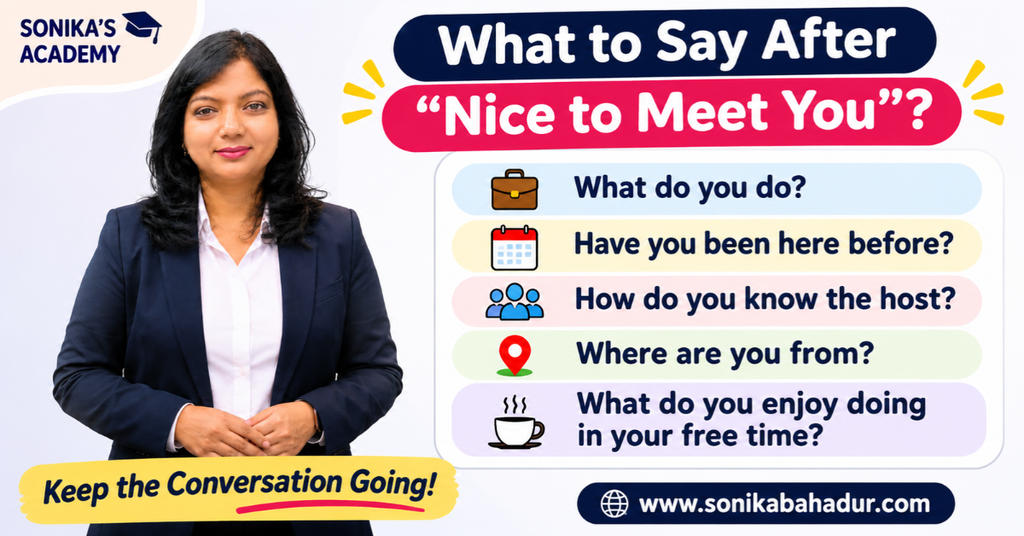
Here are 10 useful expressions:
- How is your day going so far?
- What brings you here today?
- How do you know the host?
- Is this your first time here?
- What do you do for a living?
- Where are you from originally?
- Have you been here before?
- How long have you been living here?
- What do you enjoy doing in your free time?
- It’s great to finally meet you in person!
For example:
Person A: Hi! I’m Sarah.
Person B: Hello, Sarah. I’m Alex. Nice to meet you!
Person A: Nice to meet you too.
Person B: How is your day going so far?
See? The conversation continues naturally without requiring difficult grammar or advanced vocabulary.
My tip: Memorise three or four questions from this list. You don’t need to memorise all ten at once. Practise using them until they become a natural part of your speaking.
2. What to Say After Nice to Meet You in Different Situations
Here’s where things become interesting. The best follow-up sentence depends on where you’re meeting someone.
You wouldn’t necessarily ask a new colleague the same questions you would ask someone at a birthday party, would you?
Let’s explore some common situations.
A. When Meeting Someone at Work
Meeting new colleagues can feel uncomfortable, especially when English isn’t your first language. However, a few professional but friendly questions can make things easier.
Try these expressions:
- How long have you been with the company?
- Which department do you work in?
- What kind of work do you do here?
- How has your experience been so far?
- Is this your first year with the company?
- What projects are you currently working on?
- How do you like working here?
- Have you always worked in this industry?
Example conversation:
You: Hi, I’m Priya. Nice to meet you.
Colleague: Nice to meet you too.
You: How long have you been with the company?
Colleague: I’ve been here for about three years.
You: That’s great! What do you enjoy most about working here?
This is a simple way to move from introductions to a meaningful professional conversation.
B. When Meeting Someone at an Event or Party
Social gatherings are excellent opportunities to practise English. However, you may not always know how to approach someone.
Here are some friendly conversation starters:
- Have you been to this event before?
- How do you know the host?
- What do you think of the event so far?
- Have you tried the food here?
- Are you here with your friends?
- What do you usually enjoy doing on weekends?
- Is there anything interesting happening around here?
- What made you decide to attend this event?
Example conversation:
You: Hello! I’m Ravi. Nice to meet you.
Person: Nice to meet you too.
You: Have you been to this event before?
Person: No, this is my first time.
You: Mine too! How are you finding it so far?
Notice how one question leads naturally to another.
C. When Meeting Someone at a Conference or Workshop
Professional events give you a wonderful opportunity to connect with people who share your interests.
Instead of simply introducing yourself and walking away, try these questions:
- What made you attend this conference?
- Which session are you looking forward to?
- Have you attended this conference before?
- What industry are you working in?
- Have you heard the keynote speaker before?
- What did you think of the last presentation?
- Are you attending any other sessions today?
- What has been your biggest takeaway so far?
Example conversation:
You: Hi! I’m David. Nice to meet you.
Person: Nice to meet you too.
You: Have you attended this conference before?
Person: Yes, this is my second time.
You: That’s interesting! What do you enjoy most about it?
This approach helps you build connections without sounding rehearsed.
D. When Meeting Someone for the First Time in a Casual Setting
Sometimes, you meet someone through a mutual friend, in your neighbourhood, or while travelling.
In such situations, keep things relaxed.
You can say:
- So, how do you know our mutual friend?
- What do you usually do around here?
- Have you lived here long?
- What do you like most about this city?
- Do you enjoy travelling?
- Have you visited any interesting places recently?
- What do you usually do after work?
- Are you into sports or movies?
Remember, the purpose isn’t to ask question after question. It’s to find something you both enjoy talking about.
3. 15 Follow-Up Questions to Keep a Conversation Going
Now let’s learn some versatile questions that work in many situations.
These are particularly useful when you don’t know much about the other person.
| Situation | What you can say |
| Talking about work | What do you do? |
| Talking about studies | What are you studying? |
| Talking about location | Where do you live? |
| Talking about travel | Do you travel often? |
| Talking about hobbies | What do you enjoy doing? |
| Talking about food | What’s your favourite cuisine? |
| Talking about movies | Have you watched anything interesting lately? |
| Talking about weekends | How do you usually spend your weekends? |
| Talking about experience | How did you get started? |
| Talking about interests | What are you passionate about? |
| Talking about family | Do you have any siblings? |
| Talking about work experience | How long have you been doing that? |
| Talking about plans | Do you have any plans for the weekend? |
| Talking about learning | Are you learning anything new these days? |
| Talking about the present moment | How are you enjoying yourself so far? |
A useful trick: Don’t try to remember all these questions. Pick questions that match the situation and sound natural when you say them.
Also, remember that some topics, such as family, age, income, or personal relationships, may be sensitive depending on the culture and setting. Start with lighter topics and let the conversation develop naturally.
4. The Secret to Never Running Out of Things to Say
Here’s one of my favourite conversation strategies.
Instead of asking a new question every time, follow this simple three-step method:
Ask → Listen → Follow up
Let’s understand how it works.
Step 1: Ask a simple question.
You: What do you do?
Step 2: Listen carefully to the answer.
Person: I’m a graphic designer.
Step 3: Ask a follow-up question based on their answer.
You: That’s interesting! What kind of designs do you usually create?
Person: Mostly social media designs and advertisements.
You: That’s great! Do you enjoy the creative side of your work?
See how the conversation develops?
You didn’t need to prepare five different questions. You simply listened and responded to what the other person said.
Here are some useful follow-up expressions:
- Really? Tell me more about it.
- That sounds interesting!
- How did you get into that?
- What do you enjoy most about it?
- How long have you been doing that?
- That’s amazing! How was your experience?
- What happened next?
- Why did you choose that?
These expressions are extremely useful because they show interest and encourage the other person to share more.
Remember: Good conversations are not about speaking continuously. They’re about listening, responding, and showing genuine interest.
5. What If You Don’t Understand What the Other Person Says?
This is another common problem for English learners.
You start a conversation confidently, but the other person speaks quickly or uses unfamiliar words. Suddenly, you don’t know how to respond.
Don’t panic! You don’t have to pretend that you understand everything.
Instead, use these polite expressions:
- Sorry, could you say that again?
- Could you speak a little more slowly, please?
- I’m sorry, I didn’t catch that.
- What do you mean by that?
- Could you explain that a little more?
- Sorry, I missed the last part.
- Did you say you work in marketing?
- I’m still improving my English, so please bear with me.
These sentences help you keep the conversation going without feeling embarrassed.
And here’s something important: Asking someone to repeat themselves is perfectly normal. Even fluent English speakers do it!
6. How to Respond Naturally Instead of Just Saying Yes or No
One reason conversations become awkward is that learners often give very short answers.
For example:
Person A: Do you enjoy travelling?
Person B: Yes.
And then… silence!
Instead of giving one-word answers, add a little information.
Compare these examples:
Question: Do you like cooking?
- Short answer: Yes.
- Better answer: Yes, I love trying new recipes, especially Italian food.
Question: Have you visited London?
- Short answer: No.
- Better answer: Not yet, but it’s definitely on my travel list.
Question: Do you enjoy your job?
- Short answer: Yes.
- Better answer: Yes, especially because I get to meet different people every day.
Question: Do you watch movies?
- Short answer: Sometimes.
- Better answer: Yes, I enjoy watching comedy and mystery movies whenever I get some free time.
Here’s a simple formula:
Answer + One Extra Detail + Optional Question
For example:
“I love travelling. I visited Singapore last year. What about you? Do you enjoy travelling?”
This small change can make your conversations much more interesting.
7. 10 Natural Expressions to Make You Sound More Confident
Sometimes, you don’t need another question. You simply need a natural response that shows you’re interested in the conversation.
Here are ten useful expressions:
- That’s interesting!
- Really? I didn’t know that!
- Oh, that sounds exciting!
- I can relate to that.
- That’s a good point.
- I completely agree with you.
- I’ve always wanted to try that.
- That’s something new for me.
- I never thought about it that way.
- It’s been lovely talking to you.
Try using these expressions instead of repeatedly saying “Okay,” “Yes,” or “Hmm.”
They make your responses sound warmer and more natural.
8. A Simple Daily Practice Strategy to Improve Your Conversation Skills
Now that you’ve learned so many expressions, let’s turn them into speaking habits.
You don’t need a speaking partner every day. You can practise many of these situations on your own.
Try this 15-minute routine:
Minutes 1–3: Learn three expressions
Choose three sentences from this article.
For example:
- How long have you been with the company?
- Have you been here before?
- What brings you here today?
Read them aloud three times.
Minutes 4–7: Practise a conversation
Imagine you’re meeting someone at a social event.
Introduce yourself and use one of your new questions.
Then imagine the other person’s response and continue speaking.
Minutes 8–11: Practise follow-up questions
Take one answer and create two follow-up questions.
For example:
Answer: “I’m a teacher.”
Follow-up questions:
- What subjects do you teach?
- How long have you been teaching?
Minutes 12–15: Record yourself
Speak for one minute as if you’re meeting someone for the first time.
Listen to your recording and check:
- Did you introduce yourself clearly?
- Did you ask a natural follow-up question?
- Did you give complete answers?
- Did you speak without too many long pauses?
Repeat the exercise with a different situation the next day.
Within a few weeks of consistent practice, you’ll start finding it easier to think of what to say next.
9. Final Advice: Don’t Memorise Conversations, Learn Conversation Patterns
Here’s the most important lesson I want you to take away from this article.
You don’t need to memorise 100 conversations to become fluent. You need to understand how conversations work.
Most everyday conversations follow a simple pattern:
- Greet the person.
- Introduce yourself.
- Exchange a friendly response.
- Ask a relevant follow-up question.
- Listen carefully.
- Respond with an extra detail.
- Ask another question based on the answer.
For example:
You: Hi! I’m Sarah. Nice to meet you.
Person: Nice to meet you too.
You: Is this your first time at this event?
Person: Yes, it is.
You: Mine too! What made you decide to attend?
Person: I’m interested in meeting people from the industry.
You: That’s great! What kind of work do you do?
And just like that, you’ve moved from a simple greeting to a meaningful conversation.
Speak English Confidently
The Complete Self-Study Course with Practical Exercises
- 5,000+ Daily-use English sentences
- 70 Chapters based on real-life situations
- 15 Bonus Guides Included for complete learning
Frequently Asked Questions (FAQs)
1. What should I say after “Nice to meet you”?
After saying “Nice to meet you,” you can ask a friendly follow-up question such as “How is your day going?” or “What brings you here today?” You can also say something relevant to the situation, such as “Have you been to this event before?”
2. What is the best response after someone says “Nice to meet you”?
The most common responses are “Nice to meet you too,” “It’s a pleasure to meet you,” and “Likewise.” After responding, you can continue with a question to keep the conversation going.
3. How do you continue a conversation after introductions?
Start with a question related to the situation. For example, at work, ask “How long have you been with the company?” At an event, ask “Have you attended this event before?” Listen to the answer and ask a relevant follow-up question.
4. What questions can I ask someone I just met?
You can ask simple, friendly questions such as:
- What do you do?
- Where are you from?
- What brings you here?
- What do you enjoy doing in your free time?
- Have you been here before?
Choose questions that suit the setting and avoid making the conversation feel like an interview.
5. How do I avoid awkward silence in English conversations?
Ask open-ended questions, listen carefully, and respond with additional information. Instead of giving one-word answers, share a little about yourself. You can also use expressions such as “Really? Tell me more!” or “That’s interesting!”
6. How do I keep a conversation going with a stranger?
Begin with a friendly greeting and a simple question about the surroundings, the event, or the situation. Show genuine interest in the other person’s response and ask follow-up questions. Keep the conversation light and comfortable.
7. What are some good English conversation starters?
Some useful English conversation starters include:
- How has your day been?
- What do you do?
- Have you been here before?
- What brings you here today?
- What do you enjoy doing on weekends?
- Have you tried anything interesting lately?
8. How do I make small talk in English?
Start with easy topics such as work, hobbies, travel, food, or the event you’re attending. Ask simple questions, share your own experiences, and respond naturally. You don’t need advanced vocabulary to make small talk.
9. What should I say if I don’t know what to talk about?
You can ask a question about the current situation, such as “How are you enjoying the event?” or “Have you been here before?” You can also talk about shared interests or use a friendly expression such as “Tell me a little about yourself.”
10. How can beginners become better at English conversations?
Beginners should practise everyday conversations, learn useful expressions, listen to simple English dialogues, and speak aloud regularly. Start with short conversations and gradually practise longer exchanges. Focus on communicating your thoughts rather than speaking perfect English.
Conclusion
The next time you meet someone, don’t worry about finding the perfect sentence. Start with one simple question, listen to the answer, and build from there.
Confidence doesn’t come before speaking. It grows because you keep speaking.
Practise a little every day, make mistakes without fear, and give yourself time to improve. Your next conversation can be much better than your last one!
Share your thoughts
Share in the comments, if your have any query or concern. Don’t forget to subscribe for more such useful content.
I create content to make English learning simple and practical. If you find it helpful, consider supporting me. Your contribution helps me improve my skills and bring better content for you.