He Works Hard vs. He Hardly Works: The One Word That Changes Everything

Introduction
Have you ever tried to say something in English, only to realise that one small word completely changes your meaning? Imagine telling your friend, “I hardly studied for the exam,” when you actually studied day and night! Your friend might think you barely opened your books. However, you wanted to say that you worked really hard, didn’t you?
Don’t worry! This is a common English grammar mistake, and you’re not alone. Many learners believe that adding -ly to a word simply changes it into an adverb with a similar meaning. Unfortunately, that pattern does not always work in English.
The good news is that understanding the difference between hard and hardly is much easier than you might think. In this guide, we’ll explore simple grammar rules, everyday examples, common mistakes, and practical speaking exercises that will help you use these words confidently.
So, let’s clear up the confusion once and for all!
1. What Is the Difference Between Hard and Hardly?
Let’s start with the most important rule.
- Hard means with a lot of effort, energy, or difficulty.
- Hardly means almost not at all, barely, or to a very small extent.
Although these words look similar, their meanings are very different. In many sentences, hardly has an almost negative meaning.
Look at these examples:
Example 1: Studying
- I studied hard for the exam. — I put in a lot of effort.
- I hardly studied for the exam. — I studied very little.
Example 2: Working
- He works hard. — He puts a lot of effort into his job.
- He hardly works. — He does very little work.
Example 3: Sleeping
- I worked hard all day. — I made a lot of effort.
- I hardly slept last night. — I slept very little.
Can you see how the meaning changes?
Here’s an easy way to remember the difference between hard and hardly:
HARD = A LOT OF EFFORT
HARDLY = ALMOST NOT AT ALL
Whenever you feel confused, return to these two meanings. They’ll help you choose the correct word in most everyday situations.
2. What Does Hard Mean in English?
The word hard can be an adjective or an adverb, depending on how it’s used.
As an adverb, it describes an activity performed with a lot of effort. As an adjective, it can describe something difficult or something firm rather than soft.
Let’s look at its common uses.
A. Hard means with a lot of effort
We often use hard when talking about studying, working, practising, or achieving a goal.
Here are some hard and hardly examples to help you understand the difference.
- I work hard to support my family.
- She studies hard every evening.
- They trained hard for the competition.
- He is working hard to improve his English.
- We tried hard to solve the problem.
- My sister practises hard before every performance.
- The team played hard until the final whistle.
- She worked hard to get her dream job.
- I am trying hard to speak English confidently.
- You need to work hard if you want to achieve your goals.
In all these sentences, hard tells us about the effort someone makes.
B. Hard means difficult
We also use hard to describe something that isn’t easy.
Examples:
- English pronunciation is hard for me.
- This question is harder than the previous one.
- It was hard to say goodbye.
- I find it hard to speak English in front of strangers.
- Learning a new language can be hard at first.
- It is hard to concentrate when the room is noisy.
- She had a hard time understanding the instructions.
- Making new friends can be hard when you move to another city.
Notice that hard describes difficulty in these examples.
C. Hard means firm or not soft
Examples:
- This mattress is too hard.
- The ground was hard after several days without rain.
- I prefer soft pillows to hard ones.
- The bread has become hard.
- The chair has a hard seat.
Remember that the meaning depends on the context.
3. What Does Hardly Mean in English?
Now let’s focus on hardly, the word that often confuses English learners.
The hardly meaning in English is generally almost not at all, barely, or to a very small extent.
For example:
- I hardly slept last night. — I slept very little.
- She hardly eats anything in the morning. — She eats very little.
- We hardly know each other. — We know each other very little.
- He hardly speaks during meetings. — He speaks very little.
- I could hardly hear you. — I could almost not hear you.
- There is hardly any milk left. — There is almost no milk left.
- I hardly ever watch television. — I watch television very rarely.
- We had hardly any time to prepare. — We had almost no time.
- She could hardly believe her eyes. — She found it almost impossible to believe what she saw.
- He hardly noticed the difference. — He noticed it very little, if at all.
Notice that hardly doesn’t mean doing something with great effort. Instead, it suggests that something happens very little or almost doesn’t happen.
An important grammar tip
As hardly already has a negative meaning, we generally don’t add another negative word such as not in the same clause in standard English.
Say:
- I hardly know him.
- She hardly ever complains.
- We could hardly see anything.
Avoid these forms in standard English:
- I don’t hardly know him.
- She doesn’t hardly ever complain.
Instead, use hardly without the extra negative.
4. Hard vs. Hardly: 12 Examples to Make the Difference Clear
Let’s compare these sentences. Read each pair aloud and notice how the meaning changes.
| Hard | Hardly |
| He works hard. | He hardly works. |
| She studies hard. | She hardly studies. |
| I tried hard. | I hardly tried. |
| They trained hard. | They hardly trained. |
| She works hard on weekends. | She hardly works on weekends. |
| He listened hard to understand. | He hardly listened to me. |
| I looked hard for my keys. | I could hardly find my keys. |
| We worked hard to finish the project. | We hardly worked on the project. |
| He tried hard to remember my name. | He could hardly remember my name. |
| She fought hard for her rights. | She hardly fought back. |
| I practised hard for the interview. | I hardly practised for the interview. |
| We tried hard to save money. | We hardly saved any money. |
Not every sentence can be changed mechanically from hard to hardly while remaining natural. However, these examples show how the two words can express contrasting meanings in similar situations.
Pay special attention to the first pair:
He works hard suggests that he is hardworking and puts in a lot of effort.
He hardly works suggests that he does very little work.
One small word can completely change what your listener understands!
5. Why Does Adding -ly Not Always Work?
You may have learned that adding -ly to an adjective often creates an adverb.
For example:
- Quick → quickly
- Careful → carefully
- Slow → slowly
- Polite → politely
- Beautiful → beautifully
Therefore, it’s understandable that you might assume hardly means “with a lot of effort.”
However, English contains words whose meanings cannot be predicted simply by adding -ly.
Compare these examples:
- He drives carefully. — He drives with care.
- He hardly drives. — He drives very rarely.
- She speaks slowly. — She speaks at a low speed.
- She hardly speaks. — She speaks very little.
- He answered quickly. — He answered fast.
- He hardly answered. — He gave little or almost no response.
Remember this trick: Don’t assume every word ending in -ly means “in that manner.” Learn the meaning of the complete word and how it works in a sentence.
This is one of the most useful hard vs hardly grammar rules to remember.
6. Common English Grammar Mistakes With Hard and Hardly
Let’s correct some mistakes you might hear in everyday conversations.
Mistake 1: “I hardly studied for the exam.”
If you mean you studied with great effort, say:
Correct: I studied hard for the exam.
“I hardly studied” means you studied very little.
Mistake 2: “She works hardly.”
Correct: She works hard.
If you mean she does very little work, say, “She hardly works.”
Mistake 3: “I am hardly trying to improve my English.”
If you mean you’re making a serious effort, say:
Correct: I am trying hard to improve my English.
“I’m hardly trying” suggests that you’re making very little effort.
Mistake 4: “I can’t hardly hear you.”
Correct: I can hardly hear you.
This means that you can hear the person only with great difficulty.
Mistake 5: “I don’t hardly ever go out.”
If you mean you rarely go out, say:
Correct: I hardly ever go out.
Don’t feel embarrassed if you’ve made these mistakes. The goal isn’t to speak perfect English from day one. The goal is to notice your mistakes, learn the correct forms, and use them confidently next time.
7. Four Easy Tricks to Remember the Difference
Here are four practical strategies you can use whenever you’re unsure which word to choose.
Trick 1: Replace hard with “with a lot of effort”
If the replacement makes sense, you probably need hard.
For example:
“I studied hard.”
Ask yourself: Did I study with a lot of effort? Yes!
Therefore, hard is correct.
Trick 2: Replace hardly with “almost not at all”
If the replacement makes sense, use hardly.
For example:
“I hardly slept.”
Ask yourself: Did I sleep almost not at all? Yes!
Therefore, hardly is correct.
Trick 3: Memorize two opposite sentences
Remember this pair:
- I tried hard. — I made a lot of effort.
- I hardly tried. — I made very little effort.
Repeat these sentences aloud five times. Then create two sentences of your own.
Trick 4: Connect the words to your daily life
At the end of the day, ask yourself:
“Did I work hard today, or did I hardly work?”
You could also say:
“I practised English hard today.”
A more natural way to express the same idea is:
“I practised English a lot today.”
Using grammar in real-life situations makes it easier to remember.
Download the free cheat sheet
8. Speaking Practice: Use Hard and Hardly in Real Conversations
Reading grammar rules is useful, but speaking aloud helps you use English more naturally.
Try these short conversations.
Conversation 1: Preparing for an exam
A: Did you prepare well for your exam?
B: Yes, I studied hard every day.
A: That’s great! I hardly studied this week.
B: You should make a little time for revision.
Conversation 2: Talking about work
A: Is your colleague hardworking?
B: Yes, he works hard and always finishes his tasks.
A: What about the other employee?
B: He hardly works unless someone reminds him.
Conversation 3: Talking on the phone
A: Can you hear me?
B: I can hardly hear you. The connection is poor.
A: Let me call you back.
Now, practise these conversations aloud. After that, change the details and create your own dialogues.
If you’re a beginner, start with just two or three sentences. Speak slowly, focus on meaning, and repeat until the sentences feel natural.
9. Quick Practice Quiz: Hard or Hardly?
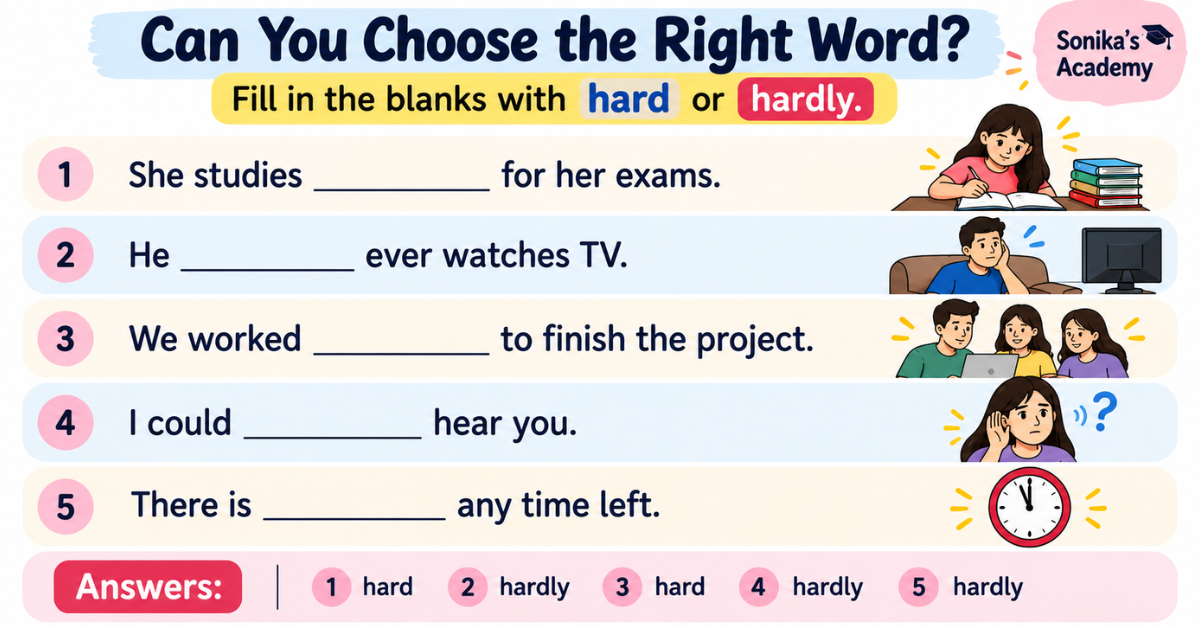
Let’s test what you’ve learned. Fill in each blank with hard or hardly.
- She studies ______ for her exams.
- He ______ ever watches television.
- We worked ______ to finish the project.
- I could ______ hear the announcement.
- There is ______ any time left.
- They trained ______ before the competition.
- I ______ know my new neighbours.
- She tried ______ to solve the problem.
- We had ______ any money left.
- If you practise ______, your English can improve.
Answers
- Hard
- Hardly
- Hard
- Hardly
- Hardly
- Hard
- Hardly
- Hard
- Hardly
- Hard
Don’t just check your answers and move on. Read each complete sentence aloud and explain its meaning in your own words.
For an extra challenge, record yourself speaking for one minute using both words. Listen to your recording and check whether you used them correctly.
10. Final Advice: Focus on Meaning, Not Just Grammar
Fluency doesn’t come from memorizing hundreds of grammar rules. It develops when you understand useful patterns and practise using them in real conversations.
Whenever you learn a confusing pair of words, follow this simple process:
- Understand the meaning of each word.
- Compare two sentences that use the words differently.
- Read the sentences aloud.
- Create examples related to your own life.
- Use the words in a short conversation.
- Review them the following day.
Most importantly, don’t wait until your English is perfect before you start speaking. Make mistakes, correct them, and keep going.
Frequently Asked Questions
1. What is the difference between hard and hardly?
Hard means with a lot of effort or difficulty. Hardly means almost not at all or to a very small extent. For example, “She studies hard” means she puts in a lot of effort, while “She hardly studies” means she studies very little.
2. Does hardly mean very hard?
No. Hardly does not mean “very hard.” It generally means almost not at all or barely. If you want to describe an activity that requires a lot of effort, use hard. For example, say, “I worked hard,” not “I worked hardly.”
3. Is it correct to say “I hardly studied”?
Yes, the sentence is grammatically correct. However, it means that you studied very little. If you studied for many hours and put in a lot of effort, say, “I studied hard.”
4. How do you use hard and hardly in a sentence?
Use hard to describe effort or difficulty: “She works hard every day.” Use hardly to express something that happens very little: “She hardly works on weekends.” The context helps you understand the difference.
5. What does “I can hardly hear you” mean?
It means that hearing the other person is very difficult. You can hear very little of what they are saying.
6. What does “I hardly ever” mean?
Hardly ever means very rarely or almost never. For example, “I hardly ever eat outside” means that eating outside is unusual for you.
7. Why is hardly considered a negative word?
Hardly has a negative meaning because it suggests that something is almost absent or happens very little. For example, “There is hardly any food left” means that almost no food remains. In standard English, it is generally used without an additional negative such as not in the same clause.
8. What are common mistakes with hard and hardly?
Common mistakes include saying “I studied hardly” when you mean “I studied hard,” or “She works hardly” when you mean “She works hard.” Remember that hard describes effort, while hardly means almost not at all.
9. How can I remember the difference between hard and hardly?
Remember these two meanings: hard = with a lot of effort; hardly = almost not at all. Practise pairs such as “I tried hard” and “I hardly tried.” Speaking these examples aloud and making your own sentences will help you remember the difference.
10. How can beginners improve their English grammar and speaking?
Beginners can improve by learning a few useful grammar patterns at a time, reading example sentences aloud, listening to simple English, and using new words in everyday conversations. Consistent practice and regular revision help build confidence and fluency.
Conclusion
Today, you learned that “I studied hard” means you put in a lot of effort, while “I hardly studied” means you studied very little.
That tiny difference can completely change what another person understands.
Keep practising these sentences, use the words in your next English conversation, and gradually build your confidence. Small improvements like these will make your English clearer, more natural, and more fluent.
Share your thoughts
Share in the comments, if your have any query or concern. Don’t forget to subscribe for more such useful content.
I create content to make English learning simple and practical. If you find it helpful, consider supporting me. Your contribution helps me improve my skills and bring better content for you.