The Ultimate Guide to English Pronunciation
Introduction:
Let me guess something about your English pronunciation.
You understand English when you read it.
You even understand when others speak.
However, when you try to speak…
You pause.
You hesitate.
You feel stuck.
And the biggest reason?
Your English pronunciation doesn’t feel right.
You’re constantly thinking:
- “Am I saying this correctly?”
- “What if they don’t understand me?”
- “What if I sound funny?”
And because of this…
You avoid speaking.
You stay silent.
You lose confidence.
Let me be very honest with you.
This is NOT your fault.
You were never properly taught English pronunciation.
You were taught:
- Grammar rules
- Vocabulary lists
- Written English
You were not taught how to actually speak clearly.
And that’s why…
You know English… but you can’t speak it confidently.
Here’s the good news:
This problem is 100% fixable.
Not with complicated rules.
Not with boring textbooks.
It is possible with simple, practical techniques.
And in this guide, I’m going to walk with you step by step.
By the end of this post, you will:
- Understand how English pronunciation really works
- Fix your common mistakes
- Speak more clearly and confidently
- Build a daily practice system
So relax.
You’re not alone anymore.
Let’s fix this — together.
Why English pronunciation Feels So Difficult
Before solving the problem, let’s understand it.
When you understand the problem…
The solution becomes easy.
1. English Is Not What It Looks Like
For example n Hindi, what you see is what you say.
It is not the same in English?
“Knife” → not “k-nife”
“Honest” → not “h-onest”
“Island” → not “is-land”
Silent letters destroy your confidence in English pronunciation.
2. Same Letter, Different Sounds
“A” in:
- Cat
- Car
- Cake
All different sounds.
3. Mother Tongue Influence
We naturally speak English the way we speak Hindi.
Examples:
- “School” → “Iskool”
- “Station” → “Isteshan”
- “Very” → “Wery”
This affects your English pronunciation deeply.
4. Fear of Judgment
Even if you know the correct pronunciation…
Fear stops you.
And this fear is the biggest barrier.
What is English pronunciation
Let’s simplify it.
English pronunciation = the way words SOUND, not how they LOOK.
English has:
- 26 letters
- around 44 sounds
That’s why:
Same spelling does not mean same sound
Same sound does not mean same spelling
Once you understand this…
Your journey becomes easier.
Understanding English Sounds
Let’s build your foundation.
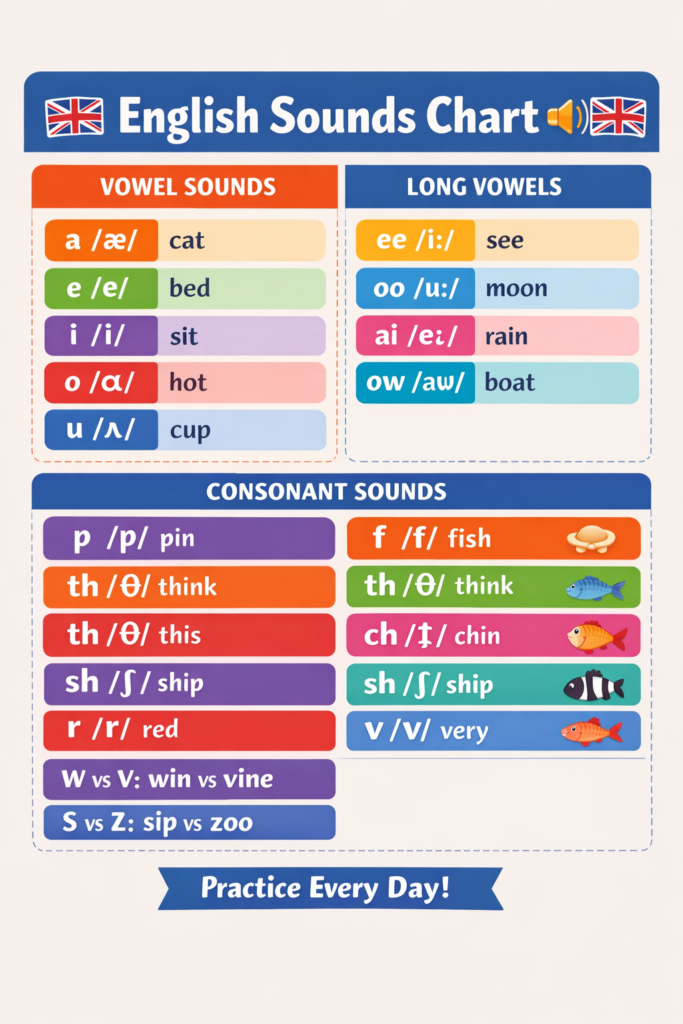
Vowel Sounds
Short vowels:
- “a” → cat
- “e” → bed
- “i” → sit
- “o” → hot
- “u” → cup
Long vowels:
- “ee” → see
- “oo” → food
- “ai” → rain
Consonant Sounds
Important ones:
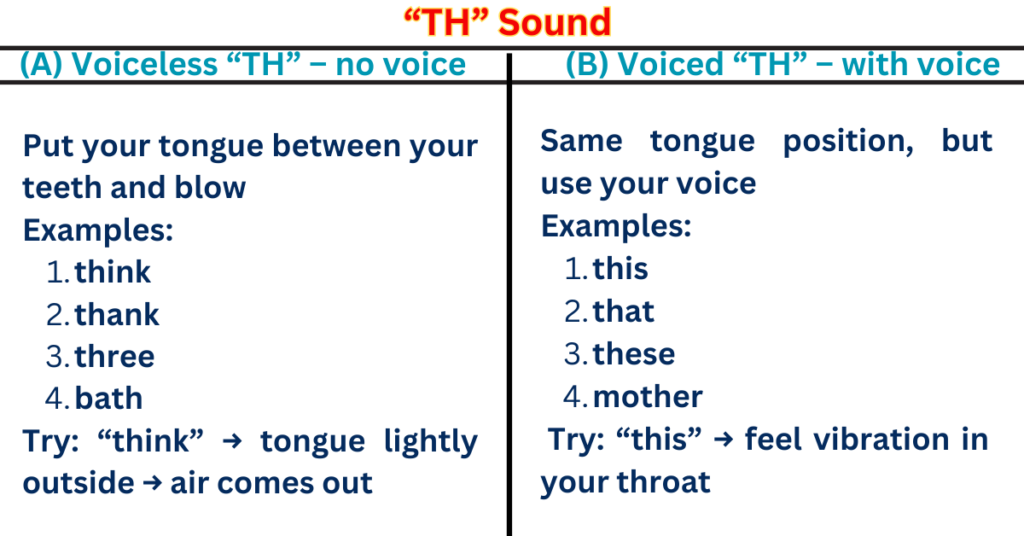
- “th” → think (soft)
- “th” → this (hard)
- “v” vs “w”
- “p” vs “f”
Example:
- Vine vs Wine
- Fan vs Pan
These are very important for clear English pronunciation.
Common Mistakes in English pronunciation
Let’s fix real-life mistakes.
Mistake 1: Adding Extra Sounds
“School” → Iskool
Mistake 2: Wrong Stress
DEsert vs deSERT
Stress changes meaning.
Mistake 3: Ignoring Silent Letters
Debt → Det
Doubt → Dout
Mistake 4: Mixing Sounds
Very → Wery
Ship → Sheep
The Real Problem (Truth You Must Accept)
Let me tell you something important.
Your problem is NOT lack of knowledge.
Your problem is lack of practice with correct sounds.
You’ve learned English without getting actively involved in speaking.
Now you need active speaking.
Now Let’s Fix Everything
This is where your transformation begins.
Strategy 1: Listen Like a Beginner
Stop trying to understand everything.
Start focusing on:
How words SOUND
Watch:
- Short videos
- Conversations
Repeat mentally.
Strategy 2: Shadowing
This is a game-changer for English pronunciation.
How to do it:
- Play a sentence
- Pause
- Repeat immediately
Example:
Audio: “I am going to the market.”
You: “I am going to the market.”
Do this daily.
Strategy 3: Record Yourself
Yes, it feels uncomfortable but it works like magic.
Speak
Record
Listen
You will instantly notice errors in your English pronunciation.
Strategy 4: Speak Slowly
Don’t rush.
Slow = clear
Fast = confusing
Strategy 5: Break Words
Example:
“Comfortable”
→ Comf-ter-ble
Practice slowly.
Strategy 6: Train Your Mouth
English uses different mouth movements.
Practice sounds:
- “th”
- “r”
- “w”
Strategy 7: Think in English
Start small:
- I am eating
- I am working
- I am tired
This improves fluency + English pronunciation.
Daily Practice Plan
Follow this:
15-Minute Routine
- 5 min → Listening
- 5 min → Shadowing
- 5 min → Speaking
Consistency is the key.
Fluency Tricks for Beginners
Even with basic English pronunciation, you can speak confidently.
Trick 1: Use Simple Sentences
Don’t complicate.
Trick 2: Repeat Common Phrases
How are you?
What are you doing?
Trick 3: Practice Daily Situations
Talking to friends
Ordering food
Asking questions
Tools to Improve English pronunciation
Use free tools:
Google pronunciation
YouTube
Podcasts
Search:
“word + pronunciation”
Real-Life Practice Ideas
Speak in front of mirror
Talk to yourself
Describe your day
Example:
“Today I woke up early…”
“Now I am working…”
Mindset Shift
Let’s be real.
You WILL make mistakes.
You need to understand:
Mistakes = progress
No mistakes = no growth.
Frequently Asked Questions (FAQs)
1. How to improve English pronunciation fast?
Practice daily using listening, shadowing, and speaking. Focus on sounds, not spelling.
2. What are the best tips for English pronunciation for beginners?
Start with simple words, practice daily, and repeat after native speakers.
3. Can I improve English pronunciation at home?
Yes, with self-practice, recording, and consistent speaking, you can improve easily.
4. Why is English pronunciation difficult for Indians?
It is because of mother tongue influence, silent letters, and different sound patterns.
5. How long does it take to improve English pronunciation?
With daily practice, noticeable improvement can happen within a few weeks.
Conclusion
Let me remind you again:
You are NOT bad at English.
You just need:
- The right method
- Daily practice
- Confidence
And slowly…
Your English pronunciation will improve.
Step by step.
Day by day.
Share your thoughts:
Share in the comments, if your have any query or concern. Don’t forget to subscribe for more such useful content.
I create content to make English learning simple and practical. If you find it helpful, consider supporting me. Your contribution helps me improve my skills and bring better content for you.