
Introduction
Do you want your child to speak English confidently, but feel confused about where to begin?
Perhaps you have tried asking your child to “Speak in English”, but you usually get a blank look.
Or maybe your child understands English when watching cartoons, listening to teachers, or reading simple sentences—but when it is time to speak English, suddenly there is utter silence.
You may even know English yourself, but you don’t feel confident enough to have long conversations with your child.
If this sounds familiar, don’t worry.
You do not need perfect English to help your child learn English.
You don’t need complicated grammar lessons. You don’t need to sit with your child for one hour every day. And you certainly don’t need to turn your home into a classroom.
What you need is something much simpler:
Small English conversations repeated every day.
In this post, I will give you 50 English sentences parents can use with their children in everyday situations. More importantly, I will show you how to use these sentences naturally, even if you and your child are beginners.
Remember this:
Children learn to speak English by using English—not by only studying English.
Therefore, let’s make your home a place where English becomes a natural part of everyday life.
Why Is It So Difficult for Children to Speak English?
Let’s first understand the real problem.
Many children study English for years. They learn grammar rules, memorise vocabulary, complete worksheets, and write answers in their notebooks.
Yet when someone asks them:
“Tell me something about your day.”
They suddenly don’t know what to say.
Why?
It is because knowing English and speaking English are two different skills.
A child may know the word “hungry”, but may not automatically say:
“I am hungry.”
They may know “water”, but instead of saying:
“Can I have some water, please?”
They simply point at the bottle.
This happens because children need repeated opportunities to use English in real situations.
And this is where parents have a wonderful advantage.
You don’t need special teaching equipment.
You already have hundreds of daily situations:
Getting up.
Brushing teeth.
Having breakfast.
Getting dressed.
Going to school.
Doing homework.
Playing.
Watching television.
Eating dinner.
Going to bed.
Every one of these moments can become English speaking practice at home.
The 50 English Sentences Parents Can Use With Their Children
Don’t try to teach all 50 sentences at once.
Instead, choose 5–10 sentences and use them repeatedly during the week.
The goal is not memorisation.
The goal is natural usage.
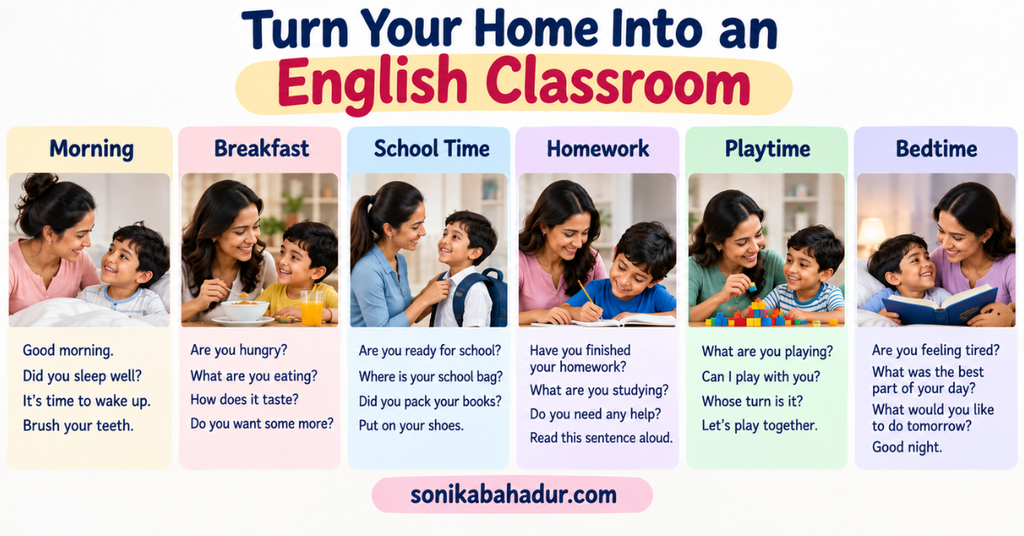
Morning Routine
Start with the easiest part of the day: the morning.
1. Good morning! Did you sleep well?
Instead of simply saying “Good morning,” add a small question.
Your child can reply:
“Yes, I slept well.”
or simply:
“Yes, I did.”
2. It’s time to wake up.
Use this every morning instead of switching between your native language and English.
You can make it playful:
“Come on, sleepyhead. It’s time to wake up!”
3. Did you brush your teeth?
Encourage your child to answer:
“Yes, I brushed my teeth.”
4. Go and wash your face.
This is a simple command that children can understand from the situation.
5. What do you want for breakfast?
Now you are creating an opportunity for your child to speak.
For example:
“I want eggs.”
“I want bread.”
“I want cereal.”
Even a two-word answer is a good beginning.
During Breakfast
Mealtimes are excellent for English conversation for kids because everyone is usually sitting together.
6. Are you hungry?
Your child can answer:
“Yes, I am.”
or
“No, I’m not.”
7. How does it taste?
Instead of teaching adjectives from a textbook, introduce them naturally.
Your child might say:
“It’s good.”
“It’s sweet.”
“It’s spicy.”
8. Do you want some more?
Teach useful everyday responses:
“Yes, please.”
“No, thank you.”
9. What are you eating?
Your child can answer:
“I’m eating an egg.”
“I’m eating toast.”
10. Please finish your breakfast.
Simple instructions like this expose children to English repeatedly.
Getting Ready for School
Now turn the morning rush into daily English sentences for kids.
11. Are you ready for school?
Possible answer:
“Yes, I’m ready.”
12. Where is your school bag?
This teaches your child to understand and respond to everyday questions.
13. Did you pack your books?
You can extend the conversation:
“Did you pack your English book?”
“Did you pack your lunch?”
14. Put on your shoes.
Short sentences are especially useful for beginners.
15. Don’t forget your water bottle.
Your child will hear this sentence in a real situation, making it easier to remember.
After School
This is one of the best times for English speaking practice at home.
Instead of immediately asking:
“How was school?”
Moving on, ask small questions.
16. How was your day?
If your child struggles, give choices:
“Was it good or bad?”
This makes speaking easier.
17. What did you learn today?
Don’t worry if your child gives only one sentence.
For example:
“I learned about plants.”
That’s enough.
18. Who did you play with?
Possible response:
“I played with Rahul.”
19. What did you eat at school?
Your child might say:
“I ate a sandwich.”
20. Did you enjoy your day?
Now your child is practising the past tense without sitting through a grammar lecture.
Homework Time
Homework gives you another natural opportunity to use English sentences for parents and children.
21. Have you finished your homework?
22. What are you studying?
23. Do you need any help?
24. Read this sentence aloud.
25. Try it again.
Notice something important here.
You are not teaching a grammar rule.
You are giving your child useful English that has a purpose.
That is exactly what beginners need.
Playtime
Don’t underestimate play.
Children often speak more freely when they are relaxed.
26. What are you playing?
27. Can I play with you?
This can even become a fun role-play activity.
28. Whose turn is it?
29. It’s your turn now.
30. Let’s play together.
You can create many variations:
“Let’s build a house.”
“Let’s play with the ball.”
“Let’s play a game.”
“What should we play?”
Suddenly, playtime has become spoken English for children.
Talking About Feelings
Children also need English for expressing emotions.
31. How are you feeling today?
32. Are you happy?
33. Why are you sad?
34. Are you angry?
35. Don’t worry. Everything will be okay.
You can also teach:
“I’m happy.”
“I’m tired.”
“I’m angry.”
“I’m excited.”
“I’m scared.”
These are extremely useful English sentences for children because they connect language with real feelings.
Evening Conversations
Evening is a great time to slow down and have slightly longer conversations.
36. What would you like to do now?
37. Do you want to watch TV?
38. What would you like to watch?
39. Did you enjoy the show?
40. What was your favourite part?
Don’t worry if your child answers with only a few words.
If your child says:
“The funny part.”
you can gently expand it:
“You liked the funny part?”
Then your child may naturally say:
“Yes, I liked the funny part.”
This technique is extremely powerful.
Dinner Time
Use dinner to create a simple daily English conversation at home.
41. Are you ready for dinner?
42. What would you like to eat?
43. Would you like some rice?
44. Do you like this dish?
45. What is your favourite food?
You can continue with:
“Why do you like it?”
“Who makes it for you?”
“How often do you eat it?”
One simple question can become a five-minute conversation.
Bedtime
Finally, use bedtime for gentle English conversations.
46. Are you feeling tired?
47. What was the best part of your day?
48. What did you enjoy today?
49. What would you like to do tomorrow?
50. Good night. Sleep well.
And don’t underestimate the power of repetition.
When your child hears the same sentence every night, it gradually becomes familiar.
Eventually, your child may start saying:
“Good night, Mom!” without being asked.
That is progress.
How to Actually Make Your Child Speak English
Now comes the most important part.
Simply reading these 50 English sentences parents can use with their children will not magically make your child fluent.
You need to use them correctly.
Here are the strategies I recommend.
1. Don’t Try to Speak English All Day
This is one of the biggest mistakes parents make.
They suddenly decide:
“From today, we will speak only English at home.”
After two days, everyone becomes frustrated.
Instead, start small.
Choose one English time.
For example:
Breakfast = English time.
After one week, add:
Bedtime = English time.
Then add:
Playtime = English time.
Little by little, English becomes normal.
2. Use the 5-Sentence Rule
Choose only five sentences for one week.
For example:
- Are you hungry?
- What do you want to eat?
- Do you want some more?
- How does it taste?
- Are you finished?
Use these sentences every day.
Once your child becomes comfortable, replace them with five new ones.
This is much better than trying to memorise 100 sentences in one day.
3. Don’t Correct Every Mistake
This is perhaps the most important advice I can give parents.
Suppose your child says:
“I goed to school.”
Don’t immediately say:
“Wrong! It’s went, not goed.”
Your child may become afraid of speaking.
Instead, respond naturally:
“Oh, you went to school. What did you do there?”
You have corrected the sentence without making your child feel embarrassed.
Remember:
Confidence comes before perfection.
4. Expand Your Child’s Answer
This is one of my favourite strategies for how to improve child’s English speaking.
Suppose you ask:
“What did you eat?”
Your child says:
“Pizza.”
Don’t say:
“Speak in a complete sentence.”
Instead, model the sentence:
“I ate pizza.”
Then ask:
“Was it tasty?”
Your child might say:
“Yes, it was tasty.”
A one-word answer has now become a mini conversation.
5. Give Choices When Your Child Gets Stuck
Beginners often don’t answer because they don’t know how to construct the sentence.
Therefore, make it easier.
Instead of:
“What do you want?”
try:
“Do you want milk or juice?”
The child can answer:
“I want juice.”
Later, remove the choices.
“What do you want to drink?”
This gradually builds confidence.
6. Use Actions
Don’t translate every sentence.
If you say:
“Open the door.”
while pointing at the door, your child can understand the meaning from the action.
Similarly:
“Bring your shoes.”
“Sit down.”
“Stand up.”
“Give me the book.”
“Put it here.”
Actions make easy English sentences for kids easier to understand.
7. Turn Mistakes Into Learning Opportunities
Suppose your child says:
“Give me water.”
Instead of scolding them for being impolite, model:
“Can I have some water, please?”
Then encourage them to repeat it.
You are teaching both English and polite communication at the same time.
8. Ask Open-Ended Questions
Once your child becomes comfortable, move beyond yes/no questions.
Instead of:
“Did you enjoy school?”
ask:
“What did you enjoy at school today?”
Instead of:
“Do you like the story?”
ask:
“Which part of the story did you like?”
These questions encourage longer answers.
9. Use English During Real-Life Activities
You don’t need special lessons.
Try English while:
Cooking:
“What are we making?”
Shopping:
“What do we need?”
Cleaning:
“Where should we put this?”
Travelling:
“What can you see outside?”
Walking:
“Look! What is that?”
Playing:
“What should we play?”
This is how you create English practice for kids at home without making it feel like homework.
10. Celebrate Small Wins
If your child speaks one English sentence today, celebrate it.
If tomorrow they speak two sentences, celebrate again.
Don’t compare them with another child.
Don’t say:
“Look at your cousin. She speaks much better English.”
Instead say:
“You spoke that sentence really well!”
Your goal is not to make your child perfect overnight.
Your goal is to make your child comfortable using English.
And comfort comes through repetition.
A Simple 15-Minute Daily English Routine
If you don’t know where to start, try this.
Minutes 1–5: Morning Conversation
Use simple questions:
“Did you sleep well?”
“Are you hungry?”
“What do you want for breakfast?”
Minutes 6–10: Activity Conversation
During play, homework, cooking, or another activity, use English naturally.
Ask:
“What are you doing?”
“What do you need?”
“Can you help me?”
Minutes 11–15: Evening Conversation
Ask:
“How was your day?”
“What did you enjoy?”
“What do you want to do tomorrow?”
That’s it.
You don’t need an hour.
15 consistent minutes every day can be more useful than a long English lesson once a week.
One Final Trick: Don’t Make English Feel Like a Test
This is the secret many parents miss.
If every English conversation feels like an examination, your child will naturally avoid it.
Instead, make English part of life.
Laugh in English.
Play in English.
Ask questions in English.
Tell stories in English.
Talk about food in English.
Talk about cartoons in English.
Talk about their day in English.
And sometimes, just make silly sentences together.
For example:
Parent: “My teddy is hungry!”
Child: “No, he isn’t!”
Parent: “Why not?”
Child: “Because he ate five bananas!”
Now your child is speaking English—and probably doesn’t even realise that they are practising.
That is exactly what we want.
FAQs
1. How can I teach my child English at home?
You can teach your child English at home by using simple English during everyday activities such as eating, getting ready, playing, doing homework, and going to bed. Start with a few daily English sentences for kids and repeat them regularly.
2. How can I make my child speak English?
To make children speak English, don’t force them to give long answers. Start with simple questions, give choices when they get stuck, model the correct sentence, and encourage every attempt. The more relaxed and regular the practice, the more comfortable children become.
3. What are some easy English sentences for kids?
Useful easy English sentences for kids include:
“Are you hungry?”
“What are you doing?”
“Do you need help?”
“Where is your bag?”
“What do you want?”
“How was your day?”
4. How can parents improve their child’s English speaking?
Parents can improve their child’s English speaking by creating short English conversations every day. Instead of teaching only vocabulary and grammar, encourage children to use English while talking about real-life situations.
5. How much English should I speak with my child every day?
You don’t need to speak English all day. Start with 10–15 minutes of English speaking practice at home and gradually increase the amount as your child becomes more comfortable.
6. What should I do if my child refuses to speak English?
Don’t turn English into a punishment or test. Start with games, stories, cartoons, and activities your child already enjoys. Use very easy sentences and celebrate small attempts.
7. Should I correct my child’s English mistakes?
Yes, but avoid correcting every mistake directly. Instead, model the correct sentence naturally. If your child says, “I goed there,” you can say, “Oh, you went there?” This keeps the conversation going while providing the correct form.
8. Can parents with weak English help their children learn English?
Absolutely. Parents don’t need perfect English. They can begin with simple English sentences for parents and children, learn a few useful expressions, and practice together with their child.
9. How can I improve my child’s English vocabulary?
Use new words in real situations instead of asking your child to memorise long word lists. For example, while cooking, introduce words such as plate, spoon, hot, cold, cut, wash, and eat and use them repeatedly.
10. How can I help my child speak English fluently?
English fluency develops through regular use. Give your child frequent opportunities to listen, respond, describe things, ask questions, tell stories, and have simple conversations. Focus on confidence first and accuracy gradually.
Conclusion
Helping your child speak English confidently does not have to begin with complicated grammar books or expensive classes.
It can begin with one simple sentence at breakfast.
Then another during playtime.
Then another before bed.
The 50 English sentences parents can use with their children in this guide are simply starting points. Once you become comfortable using them, you can create hundreds of new sentences from your child’s everyday activities.
Most importantly, remember this:
Don’t wait for your child to become good at English before asking them to speak English.
Let them speak simple English now.
Let them make mistakes.
Let them use short sentences.
Let them repeat the same expressions again and again.
It is because slowly, those little sentences become conversations.
Those conversations become confidence.
And with regular practice, English can become a natural part of your child’s everyday life.
Share your thoughts:
Share in the comments, if your have any query or concern. Don’t forget to subscribe for more such useful content.
I create content to make English learning simple and practical. If you find it helpful, consider supporting me. Your contribution helps me improve my skills and bring better content for you.