Learning English with Podcasts, Movies and Songs
Introduction
You know grammar.
You know many English words.
You may have watched hundreds of English videos on YouTube.
Yet, when it’s time to speak…
Your mind goes blank.
You start translating from your native language.
You become nervous.
Simple sentences suddenly feel difficult.
And then you think:
“Maybe English is not for me.”
Listen carefully…
That is NOT the real problem.
The real problem is this:
You learned English like a school subject…
instead of, learning it like a language.
A language is not memorized.
A language is absorbed.
Think about how you learned your native language as a child. Nobody gave you grammar books first. You listened to people around you every single day. Slowly, your brain internalized patterns, pronunciation, emotions, expressions, and sentence structures.
That is exactly how fluent English speakers become fluent.
They listen again and again.
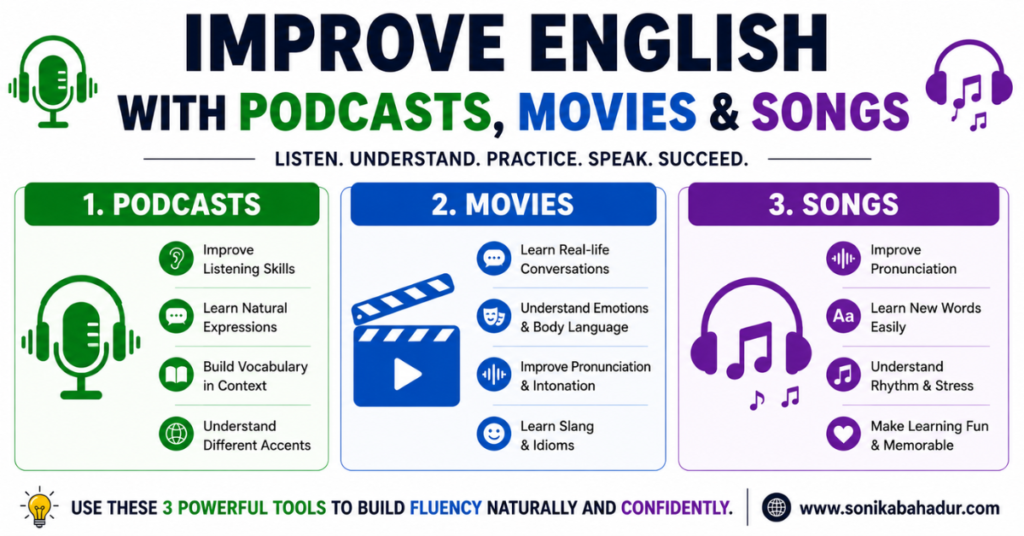
And this is where English with podcasts, movies, and songs becomes life-changing.
These things teach you:
- Real English
- Natural pronunciation
- Everyday expressions
- Emotion and tone
- Native speaking speed
- Confidence in conversations
Most importantly…
They make English learning enjoyable.
And when learning becomes enjoyable, consistency becomes easy.
Hence, if you are a beginner…
if you are shy…
if you think your English is weak…
Relax!
You do not need expensive coaching.
You do not need to memorize thousands of grammar rules.
You do not need a foreign accent.
You simply need the right strategy.
In this guide, I’ll show you exactly how to improve your English using podcasts, movies, and songs — step by step — even if your English is basic.
By the end of this post, you will know:
- How to use English with podcasts effectively
- Which movies help beginners the most
- How songs improve pronunciation
- Daily fluency routines
- Shadowing techniques
- Listening hacks
- Vocabulary tricks
- Speaking practice methods
- Confidence-building exercises
- Beginner mistakes to avoid
And trust me…
If you follow these methods consistently for a few months, your English will improve.
Let’s begin.
Why Traditional English Learning Often Fails
Many learners spend years studying English but they cannot speak confidently.
Why?
It is because schools mostly focus on:
- Grammar rules
- Writing exams
- Memorization
- Translation
- Filling blanks
The fact is that real-life English is different.
Real English is fast.
Real English is emotional.
Real English is connected.
For example:
In books:
“How are you?”
In real life:
“How’re you?”
In books:
“I am going to.”
In real life:
“I’m gonna.”
This is why many students understand written English but struggle with spoken English.
That’s why learn english with movies, podcasts, and songs works better for fluency.
They expose your brain to natural English repeatedly.
Why English with Podcasts Is So Powerful
Among all learning methods, English with podcasts is one of the best.
Why?
It is because podcasts train your ears.
And your ears are the gateway to fluency.
If you cannot understand spoken English, you cannot reply confidently.
Podcasts help you:
- Improve listening skills
- Learn natural sentence structures
- Understand pronunciation
- Copy speaking rhythm
- Learn new vocabulary naturally
- Build confidence slowly
The best part?
You can listen anywhere.
- While walking
- While cooking
- While traveling
- Before sleeping
- During exercise
That means you can practice English without extra effort.
Best Podcasts for Beginners
Not all podcasts are beginner-friendly.
Start with slow and simple podcasts.
Here are some great categories:
1. English Learning Podcasts
These are specially designed for learners.
Examples:
- BBC Learning English
- The English We Speak
These podcasts use slower English and explain meanings clearly.
2. Story Podcasts
Stories make learning easier because your brain remembers emotions.
Listen to:
- Short stories
- Mystery stories
- Motivational stories
- Daily-life stories
Example:
Instead of memorizing:
“I was shocked.”
You hear it naturally inside a story.
That makes the phrase stay in your memory longer.
3. Conversation Podcasts
These help you learn real communication.
You learn:
- Greetings
- Reactions
- Small talk
- Daily expressions
- Informal English
Example:
“No way!”
“That’s awesome!”
“I’m kidding.”
“You’ve got to be kidding me.”
These expressions make your English sound natural.
The Correct Way to Learn English with Podcasts
Many learners make one mistake:
They only listen without actively engaging in it.
Passive listening helps a little.
Active listening changes your English completely.
Here’s the proper method:
Step 1: Listen Without Subtitles
First, just listen.
Do not worry about understanding every word.
Focus on:
- Tone
- Emotion
- Familiar words
- Pronunciation
This trains your ears.
Step 2: Listen Again with Transcript
Now read the transcript while listening.
Suddenly, many confusing sounds become clear.
Example:
You may hear:
“Whaddaya doing?”
Transcript:
“What are you doing?”
Now your brain connects spoken English with written English.
Step 3: Copy the Speaker
This is extremely important.
Pause after every sentence and repeat it exactly.
Copy:
- Pronunciation
- Speed
- Emotion
- Stress
- Intonation
This technique is called shadowing.
And it is magical for fluency.
The Shadowing Technique That Builds Fluency Fast
Shadowing means speaking immediately after the speaker.
Example:
Podcast says:
“I don’t think that’s a good idea.”
You repeat:
“I don’t think that’s a good idea.”
Do this daily for 15 minutes.
Benefits:
- Better pronunciation
- Faster speaking
- Natural rhythm
- Reduced hesitation
- Improved confidence
At first, it feels difficult.
But after some weeks, your mouth starts making English sentences automatically.
That is real progress.
How Movies Improve Spoken English
Movies teach emotional English.
You learn:
- Expressions
- Body language
- Reactions
- Slang
- Real conversations
Movies also help you understand how native speakers actually communicate.
That is why learn English with movies is extremely effective.
Best Movie Types for Beginners
Do not start with difficult movies.
Avoid:
- Fast-action films
- Heavy slang movies
- Complex crime dramas
Instead, begin with:
- Animated movies
- Romantic comedies
- Family movies
- Teen dramas
These have simpler English.
Good beginner-friendly movies:
- Finding Nemo
- Frozen
- Toy Story
- The Pursuit of Happyness
- Home Alone
The Best Movie-Watching Strategy for English Learners
Stage 1: Watch with English Subtitles
Avoid Hindi subtitles.
Hindi subtitles make your brain translate constantly.
English subtitles help you think directly in English.
Stage 2: Watch Small Scenes Repeatedly
Do not watch 3-hour movies for learning.
Instead:
Watch 2-minute scenes repeatedly.
Repeat the dialogues.
Example:
Character says:
“I’ll call you later.”
You repeat it many times.
Soon it becomes automatic.
Stage 3: Speak Along with Characters
This is powerful.
Pretend you are the character.
Copy their voice and emotions.
This improves:
- Fluency
- Confidence
- Pronunciation
Speaking speed
How Songs Improve English
Many learners ignore songs.
Big mistake.
Songs improve:
- Pronunciation
- Listening
- Vocabulary
- Rhythm
- Memory
It is because music makes repetition enjoyable.
And repetition is the secret to fluency.
How to Learn English Through Songs
Step 1: Choose Slow Songs
Good beginner songs:
- I’m alive – Celine Dion
- wise men say – Elvis Presley
These songs have clearer pronunciation.
Step 2: Read Lyrics While Listening
This improves listening accuracy.
You notice how words connect.
Example:
“Want to” becomes “wanna”
“Going to” becomes “gonna”
Step 3: Sing Along
Do not worry about singing quality.
The goal is pronunciation practice.
Songs improve mouth flexibility and speaking rhythm.
Daily Routine to Improve English Naturally
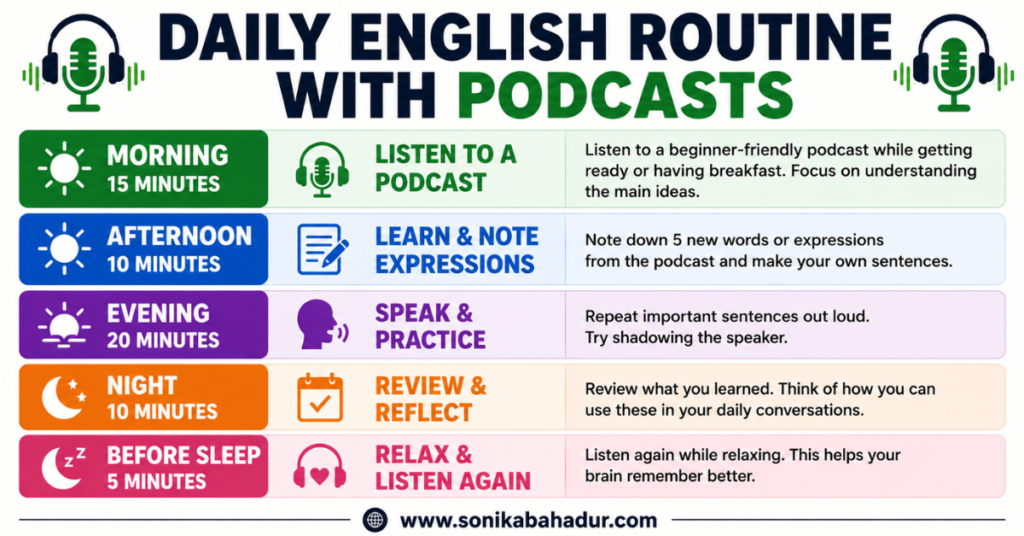
Here’s a powerful routine.
Morning (15 Minutes)
Listen to one episode of English with podcasts while getting ready.
Afternoon (10 Minutes)
Learn 5 new expressions from movies or podcasts.
Example:
- “I’m exhausted.”
- “That makes sense.”
- “I’m looking forward to it.”
Create your own sentences.
Evening (20 Minutes)
Watch one movie scene.
Repeat dialogues aloud.
Night (10 Minutes)
Listen to one English song.
Sing along while reading lyrics.
The Secret to Speaking English Faster
Many learners think:
“I need more grammar.”
No.
You need more sentence exposure.
Fluent speakers do not create sentences word by word.
They use ready-made sentence patterns.
For example:
Instead of learning:
- grammar rules
- tense formulas
Learn complete chunks:
- “What do you mean?”
- “I’m not sure.”
- “That sounds great.”
- “I’ll think about it.”
Podcasts and movies naturally teach these patterns.
Build Your Personal English Notebook
Create sections:
New Vocabulary
Example:
| Word | Meaning | Example |
| exhausted | very tired | I’m exhausted after work. |
Useful Expressions
Example:
- “No worries.”
- “Take your time.”
- “I totally agree.”
Pronunciation Practice
Write difficult words and practice them daily.
How Beginners Can Start Speaking English Immediately
You do not need perfect English to start speaking.
Start with tiny sentences.
Example:
Instead of:
“Today weather is very pleasant and enjoyable.”
Say:
“The weather is nice today.”
Simple English is powerful.
Think in English Instead of Translating
Translation slows you down.
Start thinking directly in English.
Example:
See a fan?
Think:
“The fan is moving fast.”
See tea?
Think:
“This tea is hot.”
This habit changes your brain slowly.
Talk to Yourself in English
One of the best fluency tricks.
Describe your daily activities:
“I’m opening the door.”
“Now I’m cooking food.”
“I need to buy groceries.”
This removes speaking fear.
Record Your Voice
This feels uncomfortable initially but it works amazingly.
Record yourself speaking for 2 minutes daily.
Topics:
- Your day
- Your hobbies
- Your plans
- Your favorite movie
You will notice mistakes and improvement.
How to Improve Pronunciation
Listen More Than You Speak
Good pronunciation starts with good listening.
That is why English listening practice is essential.
Copy Native Speakers
Imitate their:
- Mouth movement
- Intonation
- Stress
- Emotion
Movies and podcasts help greatly here.
Focus on Connected Speech
Native speakers connect words.
Example:
“Did you eat?”
sounds like
“Didja eat?”
Learning this improves listening dramatically.
Common Mistakes English Learners Make
1. Trying to Understand Every Word
Impossible.
Even native speakers miss words sometimes.
Focus on overall meaning.
2. Fear of Mistakes
Mistakes are part of learning.
Every learner makes thousands of mistakes before speaking fluently.
3. Learning Difficult Vocabulary First
Use common daily English.
That’s enough initially.
4. Being Inconsistent
Consistency beats intensity.
30 minutes daily is better than 5 hours once a week.
Best YouTube Channels for Listening Practice
Some useful channels:
- BBC Learning English
- Speak English With Vanessa
These are excellent for daily English listening practice
How Long Does It Take to Become Fluent?
This depends on:
- Consistency
- Practice
- Exposure
- Confidence
If you practice daily:
- 1 month → better listening
- 3 months → improved confidence
- 6 months → noticeable fluency
- 1 year → major transformation
The key is regular exposure.
Motivation: Stop Waiting for Perfect English
Many people wait until they become perfect before speaking.
That day never comes.
Fluency comes from speaking — not before speaking.
Therefore, start now.
Broken English is better than silent English.
Every sentence you speak improves your fluency.
Your 30-Day English Challenge
Week 1
- Listen to beginner podcasts daily
- Learn 5 expressions daily
- Speak for 2 minutes daily
Week 2
- Watch movie scenes repeatedly
- Start shadowing practice
- Record your voice
Week 3
- Sing English songs
- Think in English daily
- Speak with friends in simple English
Week 4
- Watch content without subtitles
- Speak longer sentences
- Practice spontaneous speaking
If you complete this challenge honestly, your confidence will increase massively.
FAQs
How to improve English with podcasts?
To improve English with podcasts, listen actively, repeat sentences, use transcripts, and practice shadowing daily. Podcasts improve listening, pronunciation, vocabulary, and speaking confidence naturally.
Can I learn English with movies?
Yes. Learn English with movies is one of the best ways to improve fluency because movies teach natural conversations, pronunciation, emotions, and real-life expressions.
How do songs improve English speaking?
Songs improve pronunciation, rhythm, listening skills, and vocabulary. Repetition through music helps your brain remember English patterns easily.
How can beginners practice English speaking daily?
Beginners can improve through:
- Talking to themselves
- Shadowing podcasts
- Repeating movie dialogues
- Recording voice notes
- Thinking in English
What is the best English listening practice method?
The best English listening practice method is active listening:
- Listen once normally
- Listen again with transcript
- Repeat sentences aloud
- Shadow the speaker
How to speak English confidently?
To how to speak English confidently, focus on communication instead of perfection. Speak daily, make mistakes fearlessly, and practice with simple sentences first.
How long does it take to improve spoken English naturally?
With daily practice using podcasts, movies, and songs, many learners notice improvement within 2–3 months and significant fluency within 6–12 months.
Can I become fluent in English without grammar?
Basic grammar helps, but fluency mainly comes from listening and speaking regularly. Exposure to natural English matters more than memorizing rules.
What are the best English learning strategies for fluency?
The best English learning strategies include:
- Daily listening
- Shadowing
- Speaking aloud
- Watching movies
- Learning sentence chunks
- Thinking in English
- Consistent practice
Conclusion
Improving English does not have to feel painful.
You do not need to study like a machine.
You can learn naturally.
You can enjoy the process.
And that is the beauty of English with podcasts, movies, and songs.
They turn learning into entertainment.
Remember:
- Listen daily
- Repeat daily
- Speak daily
- Make mistakes daily
- Improve daily
Slow progress is still progress.
One day, you will suddenly realize:
“Wow… I’m actually thinking in English now.”
And that moment will feel amazing.
Start today.
Not tomorrow.
Not next month.
Today.
Your fluent English journey begins now.
Share your thoughts:
Share in the comments, if your have any query or concern. Don’t forget to subscribe for more such useful content.
I create content to make English learning simple and practical. If you find it helpful, consider supporting me. Your contribution helps me improve my skills and bring better content for you.