
Introduction
Have you ever sent an important email at work and then… waited? One day passes. Then two days. Then three. Still no reply. Now you are stuck. You want to send a follow up email in English, but your mind fills with questions. “Will I sound rude? Will they think I am pushing them? What if my English sounds wrong?”
Don’t worry. Almost everyone feels this way. In this post, I will show you how to write a polite follow-up email in simple English. You will get 15 easy phrases, two ready examples and a few friendly tips you can use today.
Why Following Up Is Completely Normal
Most people receive dozens of emails every day. Your email may be buried under other messages. Or the person may have read it and simply forgotten to reply.
A follow-up is not rude. It is a helpful reminder. In fact, it shows that you are serious and responsible about your work.
The secret is the tone. A good follow-up is short, polite and clear.
When Should You Send a Follow-Up Email?
Here is a simple guide:
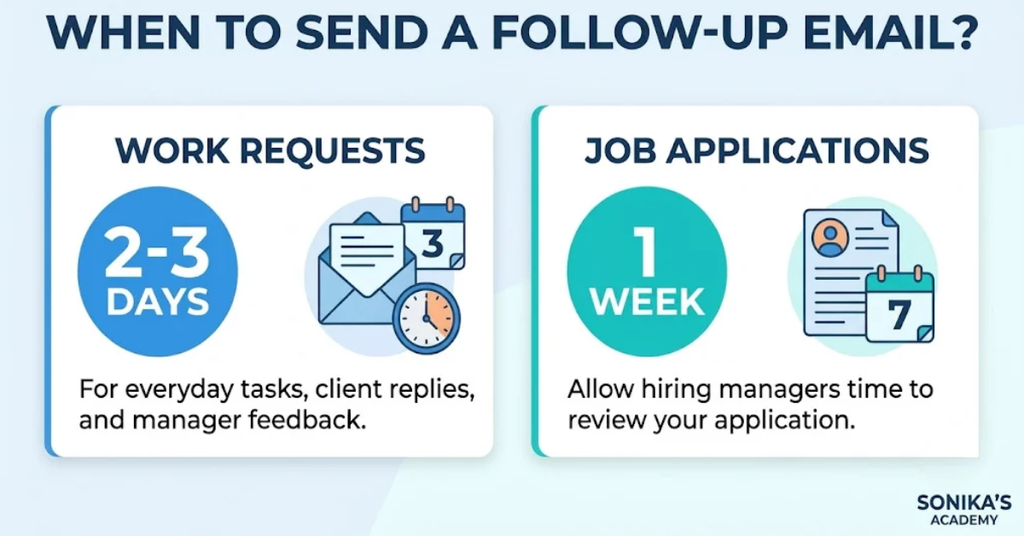
- Normal work request: wait 2 to 3 working days
- Urgent request: wait 1 day and mention the deadline
- Job application or interview: wait 5 to 7 days
- Client or business email: wait about 1 week
A small tip: Monday or Tuesday morning is usually the best time. Many people ignore emails on Friday evening because they are thinking about the weekend.
The Easy 4-Step Formula
Whenever you write a reminder email sample for work, follow these four steps:
- Greet politely: “Hi Priya, I hope you’re doing well.”
- Mention your earlier email: “I’m writing about the report I sent on Monday.”
- Make your request clear: “Could you please share your feedback by Thursday?”
- Say thank you: “Thank you for your help.”
Keep the whole email under five lines. Short emails get more replies.
15 Polite Follow-Up Email Phrases
Here are polite follow-up email phrases you can copy and use. They are grouped by situation so you can choose quickly.
First follow-up (a gentle reminder)
- “I just wanted to follow up on my previous email.”
- “I hope you’re doing well. I’m writing to check if you had a chance to look at my email.”
- “Just a gentle reminder about the details I shared on Monday.”
- “Could you please let me know the status of this request?”
- “I wanted to check in and see if you need any more information from me.”
By the way, what is the “just following up” meaning? It simply means, “I am reminding you about my earlier message.” It is polite and friendly, so you can use it with colleagues, managers and clients.
Second follow-up (when there is still no reply)
- “I’m following up again in case my last email got buried.”
- “I understand you must be busy. Whenever you get a moment, I would really appreciate your reply.”
- “Could you please share an update by Thursday?”
- “I’m sending this again because the deadline is coming closer.”
- “Please let me know if there is anything I can do to move this forward.”
Final follow-up
- “This is my last follow-up on this matter. Please let me know if this is still a priority.”
- “If now is not a good time, I’m happy to reconnect next month.”
- “Please let me know if I should contact someone else for this.”
After a meeting or an interview
- “Thank you for your time yesterday. I wanted to follow up on what we discussed.”
- “I’m still very interested in the role, and I’m happy to share anything else you need.”
Two Ready Examples
Let’s see how these phrases look in a real email.
Example 1: A follow-up at work
Subject: Follow-up: Project report feedback
Hi Priya,
I hope you’re doing well. I wanted to follow up on the project report I sent on Monday. Could you please share your feedback by Thursday? It will help me finish the next step on time.
Thank you for your help.
Best regards,
Sonika
The Professional Email Toolkit: 50 Copy-Paste Workplace Scripts
Never waste 20 minutes overthinking how to phrase a difficult workplace email again. Get 50 proven, fill-in-the-blank email scripts designed to help you sound clear, polite, and confident in every professional situation.
Get Instant Access to All 50 Scripts → Ready-to-use digital toolkit • Just fill in the blanks and hit sendWhy Professionals Love This Toolkit
Skip the blank-screen stress and write polished, high-impact workplace emails in under 60 seconds.
Know how to be firm without sounding rude, and polite without sounding unsure or overly apologetic.
Every script comes with clear [bracketed placeholders] so you can customize and send immediately.
What’s Inside the 50 Workplace Scripts
Example 2: A follow-up email after an interview
Subject: Thank you and follow-up: Software Tester interview
Dear Ms. Mehta,
Thank you for taking the time to speak with me last Tuesday. I really enjoyed learning more about your team. I wanted to follow up and ask if there is any update on the next steps. I am still very excited about the role.
Thank you again for your time.
Kind regards,
Amit Sharma
Notice how short and simple both emails are. You don’t need big words. Clear words work best. If you want more ready-made email formats, you can also look at my professional email templates.
Subject Lines That Get Opened
A good subject line helps people notice your email. Try these:
- Follow-up: [Topic]
- Quick reminder: [Topic] by [Date]
- Checking in on [Topic]
Add “Follow-up” at the beginning so the reader understands the purpose at once.
5 Common Mistakes to Avoid
- Sounding angry: Never write “Why have you not replied?” It feels rude.
- Sending too many reminders: Do not send three emails in one day.
- Writing very long emails: A follow-up should be short. Read more in my post on writing short emails that get quick replies.
- Forgetting details: Always mention the date or topic of your first email.
- Using “as per my last email”: This phrase can sound sarcastic. Use “I wanted to follow up on…” instead.
I have created a follow-up email kit for your convenience. Click below to access.
CLICK HERE
Frequently Asked Questions (FAQs)
1. How many times can I follow up on an email?
Two or three times is enough. Send the first reminder after 2 to 3 days, the second one after about a week, and then a final polite message.
2. Is it rude to send a follow-up email?
No. It is normal and professional. It becomes rude only when the tone is angry or when you send too many emails too quickly.
3. What does “just following up” mean?
It means you are gently reminding the person about your earlier email or request.
4. How long should I wait before following up?
For normal work, wait 2 to 3 working days. For job applications, wait 5 to 7 days.
5. How do I write a follow-up email after an interview?
Thank the interviewer, mention the role, say you are still interested and politely ask about the next steps. Keep it under five lines.
Conclusion
Think of one email you sent last week that did not get a reply. Using the 4-step formula, write a follow-up in just four lines. Then read it aloud once. If it sounds polite and clear, you are ready to send it.
A follow-up email is not about pushing people. It is about being clear, kind and professional. You can do it, one short email at a time.
Share your thoughts:
Share in the comments, if your have any query or concern. Don’t forget to subscribe for more such useful content.
I create content to make English learning simple and practical. If you find it helpful, consider supporting me. Your contribution helps me improve my skills and bring better content for you.