

How to Speak English Fluently Even If You’re a Beginner
Introduction
Can you speak English fluently? Let me guess.
You studied English for years.
You know grammar rules.
You can read English.
You can even write English.
However when it’s time to speak…
Your mind goes blank.
You start thinking,
“What should I say?”
“How do I say it correctly?”
“What if I make a mistake?”
“What if they laugh?”
And suddenly… your confidence disappears.
If this is your story, then listen carefully:
You are NOT weak in English.
You are NOT stupid.
You are NOT “bad at languages.”
You are simply following the wrong method.
And trust me, you are not alone.
Millions of learners face the same frustration. They study English for 5 years, 10 years, even 15 years… yet they still can’t speak English fluently.
They know English… but they can’t use English.
And that is frustrating.
In today’s world, English is not just a subject. It’s a tool. It gives confidence, better jobs, respect, and freedom in communication.
Therefore, if you’re tired of saying:
- “I understand English but I can’t speak.”
- “I know words but I can’t form sentences.”
- “I can speak in my mind but not in real life.”
Then, this post is going to change your mindset.
By the time, you reach the end of this post, you’ll understand-
Why you still can’t speak English fluently
What exactly is blocking your speaking ability
And how you can fix it step-by-step even if you are a beginner
Also, you’ll have a complete system and practical strategies that actually work.
So relax. Read slowly. And apply what you learn.
Let’s begin.
The Biggest Truth: You Learned English the Wrong Way
The biggest reason you can’t speak English fluently is simple:
You learned English like a school subject.
Speaking English is a real-life skill.
In school, we learn:
- Grammar rules
- Tenses
- Fill in the blanks
- Writing answers
- Memorizing essays
Nobody teaches us:
- how to start a conversation
- how to reply naturally
- how to think in English
- how to speak without fear
That’s why you may score 90 marks in English exams, but still feel nervous speaking to a real person.
It is because speaking is not knowledge.
Speaking is practice.
Let’s understand the real problems now.
Why You Still Can’t Speak English Fluently
1. You Know Grammar, But You Don’t Have Speaking Practice
This is the most common issue.
You might know the rule:
“I have been studying English for 5 years.”
Can you say it confidently in real time?
Most learners hesitate because they are trained to write English, not speak English.
Example:
You may write:
“I would like to inform you that I will not be able to attend the meeting.”
However, in real conversation, people say:
“Sorry, I can’t attend the meeting.”
Speaking needs simple sentences.
If you want to speak English fluently, you need English speaking practice daily, not grammar worksheets.
2. You Translate from Your Mother Tongue
This is a silent fluency killer.
When you think in Hindi (or any language) first, and then translate into English, your speaking becomes slow and confused.
Example in your mind:
“मैं कल बाजार गया था।”
Now you translate:
“I… yesterday… market… went…”
That’s why you pause too much.
Fluency means you speak without stopping but translation forces your brain to work double.
If you want to speak English fluently, you must learn to stop translating in English.
3. You Are Afraid of Mistakes
This fear is a big obstacle.
You don’t speak because you think:
- “My grammar will be wrong.”
- “My pronunciation is bad.”
- “They will judge me.”
Let me tell you a truth:
Every fluent English speaker also made mistakes.
They became fluent because they spoke anyway.
A child speaks a language fluently not because he knows grammar, but because he speaks daily without fear.
If you want to speak English confidently, you must accept mistakes as part of growth.
4. You Wait to Become Perfect Before Speaking
This is another trap.
Many learners think:
“First I will learn vocabulary.”
“First I will complete grammar.”
“First I will watch 100 videos.”
“Then I will start speaking.”
Speaking doesn’t start after learning.
Speaking starts while learning.
If you wait for perfection, you will never speak English fluently.
5. Your Vocabulary Is Passive, Not Active
You may know 1000 words, but can you use them?
That’s the difference between passive vocabulary and active vocabulary.
Example:
You know the word “beautiful.”
When it comes to speaking, you only say “nice.”
You know “delicious.”
Yet you say “tasty” again and again.
You know “frustrated.”
Yut you say “angry.”
So you feel like your English is stuck at the same level.
To improve spoken English, you must convert passive words into usable speaking words.
6. You Don’t Listen Enough
Many learners focus only on reading and grammar.
Fluency comes from listening.
When you listen daily, your brain learns:
- sentence structure
- natural phrases
- pronunciation
- rhythm
That’s why people who watch English movies and YouTube regularly often speak better than those who only study books.
To speak English fluently, listening is compulsory.
7. You Don’t Have Ready-Made Sentence Patterns
Fluent speakers don’t create sentences from scratch every time.
They use patterns.
Example patterns:
- “I think that…”
- “To be honest…”
- “In my opinion…”
- “The main reason is…”
- “Let me explain…”
These are like speaking shortcuts.
Beginners struggle because they try to create everything new.
To learn English speaking, you need ready-to-use templates.
8. You Speak Too Little in Daily Life
Be honest.
How many minutes do you speak English daily?
Most learners speak English only in class, or once in a week.
Fluency needs frequency.
If you want to speak English fluently, English must become a daily habit, not a monthly event.
A Quick Reality Check
Now listen carefully, my friend.
You can watch 1000 English videos.
You can learn 5000 vocabulary words.
You can memorize all tenses.
Still…
You will not speak English fluently unless you start speaking.
It is because fluency is a muscle.
If you don’t use the muscle, it stays weak.
So now let’s talk about the real solutions.
And yes, these strategies work even for spoken English for beginners.
How to Speak English Fluently: The Real Step-by-Step Plan
Now comes the solution part.
Read this carefully because this is where your fluency journey truly starts.
1. Start with Simple “Survival English”
Stop trying to speak advanced English.
Start with simple daily sentences.
For example:
“I would like to request you to please provide me some water.”
“Can I have some water?”
“I am not feeling well today.”
“I’m not feeling well.”
“I have completed my work.”
“I’m done.”
This is how native speakers speak.
To speak English fluently, you must first master basic daily communication.
2. Stop Studying Grammar Like a Doctor
Grammar is important, yes.
Understand that too much grammar thinking will stop your speaking.
If you keep thinking:
“Is it has or have?”
“Is it did or do?”
“Is it past perfect or past simple?”
You will freeze.
Instead, follow this rule:
Speak first. Correct later.
That’s how children learn language.
If your goal is how to speak English fluently, focus on communication, not perfection.
3. Use Sentence Templates
This is one of the best English fluency tips.
Learn sentence patterns and use them daily.
Examples:
Pattern 1: “I’m not used to…”
- “I’m not used to waking up early.”
- “I’m not used to spicy food.”
- “I’m not used to speaking English.”
Pattern 2: “The reason is…”
- “The reason is I was busy.”
- “The reason is I didn’t know.”
- “The reason is I was tired.”
Pattern 3: “I’m thinking of…”
- “I’m thinking of buying a new phone.”
- “I’m thinking of joining a gym.”
- “I’m thinking of learning English seriously.”
If you practice 5 templates daily, your speaking will become automatic.
This is how you improve spoken English faster.
4. Learn “Chunks”, Not Single Words
A chunk is a group of words used together.
Instead of learning:
“decision”
Learn:
“make a decision”
Instead of:
“attention”
Learn:
“pay attention”
Instead of:
“problem”
Learn:
“deal with a problem”
Now use them in sentences:
- “I can’t make a decision.”
- “Please pay attention.”
- “I don’t know how to deal with this problem.”
Chunks make your English sound natural and help you speak English fluently without hesitation.
5. Do Mirror Practice Every Day
This is a powerful English speaking practice method.
Stand in front of a mirror and speak for 10 minutes everyday.
Topic ideas:
- Introduce yourself
- Talk about your day
- Talk about your family
- Explain your job
- Describe your city
Example:
“Hi, my name is Rahul. I live in Pune. I work in a private company. Today I had a busy day, but I’m feeling good now.”
Yes, it may feel weird at first.
After 7 days, you will feel confident.
After 30 days, your tongue will start cooperating.
This is a secret technique to speak English confidently.
6. Practice “Self-Talk”
Talk to yourself in English while doing daily activities.
For example:
While cooking:
- “I’m cutting onions.”
- “Now I’m adding salt.”
- “The food smells good.”
While walking:
- “The weather is nice.”
- “I should walk faster.”
- “I’m feeling fresh.”
While working:
- “I need to finish this task.”
- “I’ll call him later.”
- “This is taking too much time.”
This technique helps you think in English naturally.
And when you think in English, you automatically speak English fluently.
7. Use Shadowing Technique
Shadowing means repeating after a speaker.
Pick a short video (30 seconds) and repeat line by line.
Example:
Video sentence: “I don’t know what to do right now.”
You repeat: “I don’t know what to do right now.”
Do it 5 times.
This improves:
- pronunciation
- fluency
- speed
- accent
- confidence
This is one of the fastest how to speak English without fear methods.
8. Record Yourself
Most learners hate their voice.
Yet recording is a magic mirror.
Take your phone and record a 1-minute audio daily.
Topics:
- What I did today
- My future plans
- My opinion on social media
- My favourite movie
Then listen.
You will notice:
- where you pause
- which words you repeat
- pronunciation issues
After 15 days, your fluency will improve automatically.
If you want to speak English fluently, recording is non-negotiable.
9. Use the “3 Sentence Rule” (Beginner Friendly)
Whenever you learn a new word or phrase, make 3 sentences immediately.
Example: phrase = “fed up”
- “I’m fed up with my job.”
- “I’m fed up with waiting.”
- “I’m fed up with my lazy routine.”
This builds active vocabulary.
And active vocabulary is the key to learn English speaking fast.
10. Start Speaking Even If It’s Broken English
Let me tell you a truth:
Broken English is better than silent English.
Example:
Silent
“I go market yesterday.” (broken but understandable)
Then slowly you improve:
“I went to the market yesterday.”
The first step is speaking.
Correction comes later.
If you want to speak English fluently, you must allow yourself to speak imperfectly.
Fluency Tricks That Work Like Magic
Trick 1: Speak Slowly, Not Fast
Many learners try to speak fast to sound fluent.
Fast speaking creates more mistakes.
Fluent people speak clearly, not quickly.
So slow down.
You will automatically speak English confidently.
Trick 2: Use Fillers Like Native Speakers
When you need time, use fillers.
Examples:
- “Well…”
- “Actually…”
- “Let me think…”
- “To be honest…”
These fillers make you sound natural and help you speak English fluently without awkward silence.
Trick 3: Learn “Response Lines”
In conversations, you need ready replies.
Examples:
- “That sounds great!”
- “I’m not sure about that.”
- “You’re right.”
- “That makes sense.”
- “I totally agree.”
- “I don’t think so.”
These small lines improve your English conversation practice massively.
Common Mistakes That Stop Fluency
Mistake 1: Memorizing Long Paragraphs
Memorizing speeches doesn’t help real speaking.
Instead, practice real-life conversations.
Mistake 2: Only Studying, Not Using
Knowledge without use is useless.
You must speak daily.
Mistake 3: Being Afraid of People
People don’t care as much as you think.
Most people respect effort.
So speak.
Frequently Asked Questions (FAQs)
1. Why can’t I speak English fluently even after years of learning?
Most people can’t speak English fluently because they learned English only through grammar, reading, and writing. Speaking requires daily practice, listening, and real conversation exposure. Without speaking practice, fluency never develops.
2. Can I speak English fluently without learning grammar?
Yes, you can start speaking without deep grammar. Basic grammar is useful, but fluency comes mainly from English speaking practice, learning sentence patterns, and using English daily. Grammar can be improved slowly along the way.
3. How long does it take to speak English fluently?
If you practice daily for 30–60 minutes using the right methods, you can see noticeable improvement in 30 days. Most learners can speak English fluently within 3–6 months depending on consistency.
4. What is the fastest way to improve spoken English?
The fastest way to improve spoken English is a mix of:
- daily speaking practice (self-talk + mirror practice)
- shadowing technique
- learning common sentence patterns
- listening to real spoken English daily
5. How can I speak English confidently if I feel shy?
Start speaking alone first (mirror practice and self-talk). Then record yourself daily. After 2–3 weeks, start small conversations with friends or online partners. Confidence grows naturally with repetition.
6. How can I stop translating in my mind while speaking English?
To stop translating in English, you must practice thinking in English through self-talk and daily sentence repetition. Start with simple daily sentences like:
“I’m hungry.” “I’m going out.” “I’m tired.”
Over time, your brain will respond in English automatically.
7. What should beginners do to learn English speaking quickly?
For spoken English for beginners, the best approach is:
- learn daily-use sentence templates
- speak 10 minutes daily (even broken English)
- listen to simple English videos
- practice 3 new sentences daily
8. Is watching English movies enough to speak English fluently?
Movies help listening, but they are not enough. To speak English fluently, you must also repeat dialogues, practice speaking aloud, and use those sentences in real conversation.
9. Why do I forget vocabulary while speaking?
It is because your vocabulary is passive, not active. You must practice words in sentences daily. Use the “3 Sentence Rule” to make vocabulary usable during speaking.
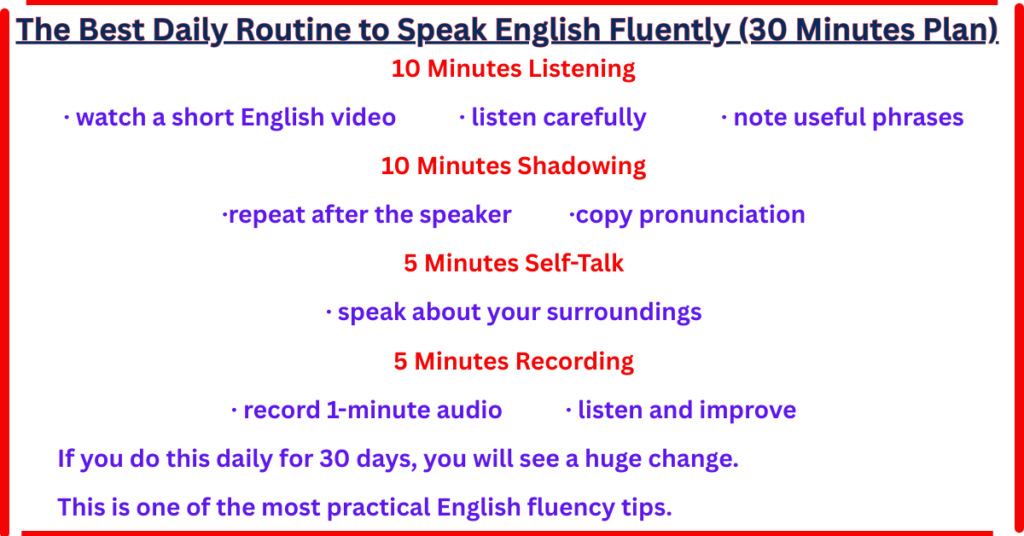
10.What is the best daily routine to speak English fluently?
A simple daily English speaking routine is:
- 10 minutes listening
- 10 minutes shadowing
- 5 minutes self-talk
- 5 minutes recording your voice
This routine builds fluency faster than traditional study.
11. How can I practice English conversation practice if I don’t have a partner?
You can practice alone using:
- self-talk
- roleplay conversations
- recording your voice
- speaking with AI tools
- joining online speaking communities
This still improves fluency strongly.
12. What are the best topics to practice speaking daily?
Some easy topics:
- My daily routine
- My job
- My childhood
- My favorite food/movie
- A recent incident
- My goals
- My opinion on social media
These topics help you build natural speaking flow.
Conclusion
Let me remind you again:
You are not bad at English.
You just trained the wrong skill.
Now you know the truth.
If you apply the strategies in this post:
- self-talk
- shadowing
- templates
- daily speaking routine
- recording
- chunk learning
You will speak English fluently sooner than you imagine.
Even if you are a beginner.
Even if you feel nervous.
Even if your English is broken today.
Because fluency is not a gift.
Fluency is a habit.
So start today.
Start small.
But start daily.
And one day, you will look back and smile because English will feel natural to you.
You will not hesitate.
You will not translate.
You will simply speak.
And yes… you will speak English fluently.
Share your thoughts:
Share in the comments, if your have any query or concern. Don’t forget to subscribe for more such useful content.
I create content to make English learning simple and practical. If you find it helpful, consider supporting me. Your contribution helps me improve my skills and bring better content for you.