
English Study Plan for Beginners to Advanced Learners
Introduction
Let me guess…
You have been learning English for years.
You understand a lot. You can read. You can even write a little.
Yet when it comes to speaking… your mind goes blank.
You hesitate. You translate. You feel nervous.
And worst of all… you feel like:
“Maybe English is not a language I can ever learn.”
“Maybe I’m too late to learn.”
“Why am I not improving?”
If this sounds like you, let me tell you something honestly—
You are not the problem. Your method is.
Most learners never follow a proper English study plan. They randomly watch videos, memorize vocabulary, or study grammar without any proper direction.
That’s like going to the gym without a workout plan—you’ll stay busy, but not get results.
And here’s the truth:
Fluency is not about talent
It’s about having the proven system.
Therefore today, I’m not just giving you tips…
I’m giving you a complete English study plan that works for every level — beginner to advanced.
If you follow this like a daily routine, you willstart speaking English.
Not someday……starting now.
Step 1: Understand How English Learning Actually Works
You must understand one simple idea before diving into the English study plan.
English is a skill, not a subject.
You don’t learn it by studying…
You can earn it only by using it.
Think about how you learned your first language:
- You listened first
- Then you spoke
- Later you read
- And finally you wrote
Whereas what do we do in English?
- Start with grammar
- Focus on rules
- Avoid speaking
That’s why we struggle.
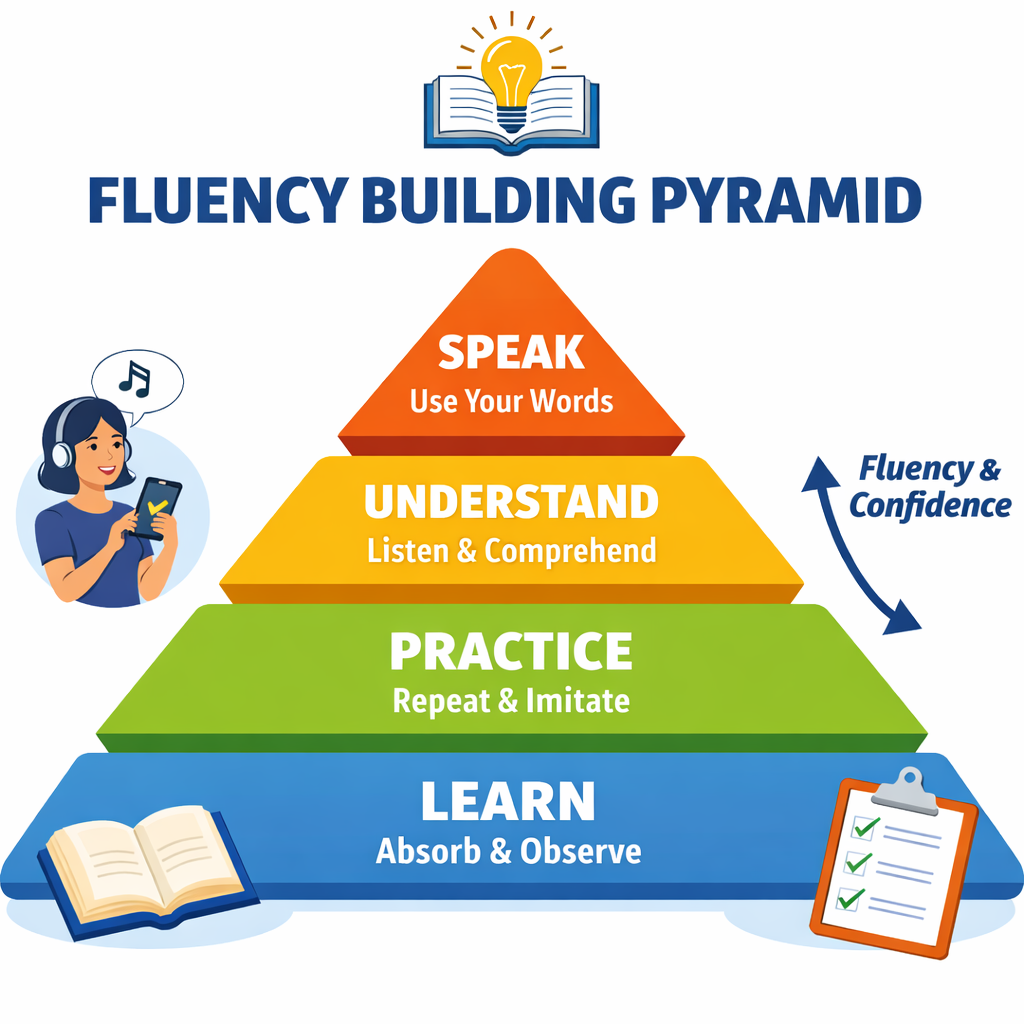
Therefore, your English learning plan must follow this order:
Listen → Speak → Read → Write
Now let’s build your step-by-step system.
Step 2: English Study Plan for Beginners
If you are a beginner, don’t worry.
You don’t need perfect grammar. You don’t need huge vocabulary.
You just need to use simple sentences confidently.
Your Goal:
Understand basic English
Speak small sentences without fear
Daily English Practice Plan (Beginner)
1. Listening (15–20 minutes)
Start with very simple content:
- Kids’ stories
- Short conversations
- Basic English videos
Example:
“Hello, how are you?”
“I am fine.”
Listen again and again.
2. Speaking Practice (20 minutes)
This is where most people fail but you won’t.
Start speaking from Day 1.
Even If, it’s broken English.
Example Practice:
I wake up at 7 AM
I eat breakfast
I go to work
Speak about your daily routine.
3. Vocabulary (10 words daily)
Don’t just memorize.
Example:
Word: “Happy”
Sentence: “I feel happy today.”
4. Think in English
Instead of:
“Mujhe paani chahiye”
Think:
“I need water”
Beginner Trick
Talk to yourself.
Yes, seriously. Whatever you do speak it out in English.
Example:
“Now I am opening the door”
“Now I am eating food”
This builds fluency faster than anything.
Step 3: English Study Plan for Intermediate Learners
Now you understand English but still struggle to speak smoothly.
Your Goal:
- Speak longer sentences
- Reduce hesitation
- Improve confidence
Daily English Practice Plan (Intermediate)
1. Listening (30 minutes)
Watch:
- Interviews
- Podcasts
- English movies (with subtitles)
2. Speaking Practice (30–40 minutes)
Start speaking on topics.
Example Topics:
- My favorite movie
- My childhood memory
- My daily routine
Speak for 2–3 minutes continuously.
3. Sentence Expansion Technique
Beginner sentence:
“I like tea.”
Intermediate:
“I like tea because it refreshes my mind.”
4. Shadowing Technique
Listen to a sentence and repeat immediately.
Example:
Audio: “I am going to the market.”
You: Repeat the same way.
This improves pronunciation and fluency.
Intermediate Trick
Stop translating.
Instead of thinking in Hindi and translate in English, think directly in English.
Step 4: English Study Plan for Advanced Learners
Now, you want to sound natural and fluent.
Your Goal:
Speak confidently in any situation
Use advanced vocabulary naturally
Sound like a fluent speaker
Daily English Practice Plan (Advanced)
1. Speak Daily (45–60 minutes)
- Speak with friends
- Join speaking groups
- Record yourself
2. Learn Natural Expressions
Instead of:
“I am very tired”
Say:
“I’m exhausted”
3. Storytelling Practice
Pick any topic and tell a story.
Example:
“Last weekend, something interesting happened…”
4. Debate Practice
Choose a topic:
Online education vs offline
Social media pros and cons
Speak both sides.
Advanced Trick
Think in English ALL THE TIME.
Make English your default language.
Step 5: Weekly English Study Plan (For All Levels)
Here’s a simple self study English plan:
Monday–Friday:
- Listening + Speaking + Vocabulary
Saturday:
- Watch a movie in English
- Speak about it
Sunday:
- Revision + Practice
Step 6: Powerful English Fluency Strategies
1. Don’t Chase Perfection
Fluency first, accuracy later.
2. Use Simple English
Instead of:
“I would like to consume food”
Say:
“I want to eat”
3. Repeat Again and Again
Repetition builds fluency.
4. Speak Daily (Non-Negotiable)
Even 10 minutes is fine.
5. Record Yourself
You will notice your mistakes and you can rectify them.
6. Use English in Real Life
- Talk to shopkeepers
- Speak with friends
- Use English on phone
Common Mistakes to Avoid
Waiting to be perfect
Only learning grammar
Not speaking daily
Fear of mistakes
Final Truth
You don’t need:
Expensive courses
Perfect grammar
Native accent
You just need:
Consistency
Practice
Right English study plan
Your Action Plan (Start Today)
Day 1:
- Speak 5 sentences
Day 3:
- Speak 10 sentences
Day 7:
- Speak for 1 minute
Day 30:
- Speak confidently
Frequently Asked Questions (FAQs)
1. What is the best English study plan for beginners?
The best English study plan for beginners focuses on listening and speaking first. Start with simple sentences, practice daily conversations, and gradually build vocabulary. Avoid focusing too much on grammar in the beginning.
2. How to create an effective English learning plan at home?
To create an effective English learning plan, divide your time into listening, speaking, reading, and writing. Follow a daily English practice plan and stay consistent. Even 30–60 minutes daily can bring great results.
3. How to learn English step by step at home?
If you are wondering how to learn English step by step, start with basic vocabulary, then move to sentence formation, daily speaking practice, and finally advanced communication skills like storytelling and discussions.
4. What is a good daily English practice plan for fluency?
A good daily English practice plan includes:
- 20 minutes listening
- 20 minutes speaking
- 10 minutes vocabulary
- 10 minutes reading
Consistency is more important than duration.
5. What are the best English speaking practice tips for beginners?
Some powerful English speaking practice tips include:
- Talk to yourself daily
- Think in English
- Use simple sentences
- Don’t fear mistakes
Speaking daily is the key to fluency.
6. Can I learn English from beginner to advanced at home?
Yes, you can definitely learn English from beginner to advanced at home by following a structured self study English plan, using online resources, and practicing speaking regularly.
7. How can I improve my fluency with English fluency tips?
To improve fluency, follow these English fluency tips:
- Speak daily
- Stop translating
- Use common phrases
- Practice shadowing
Fluency improves with regular usage.
8. What is the best self study English plan for working professionals?
The best self study English plan for working professionals includes short but consistent practice sessions. Focus on real-life conversations, listening during commute, and speaking practice daily.
9. How long does it take to speak English fluently?
If you follow a proper English study plan and practice daily, you can start seeing improvement in 30 days. However, becoming fully fluent may take 3–6 months depending on consistency.
10. What is the biggest mistake in an English study plan?
The biggest mistake in any English study plan is not practicing speaking. Many learners only focus on grammar and vocabulary, but without speaking practice, fluency is not possible.
Conclusion
Listen…fluency is not magic.
It’s a habit.
If you follow this English study plan, you will improve.
Slowly… but surely.
And one day, you’ll realize—
You are thinking in English
You are speaking without fear
You are fluent
And that day…
You’ll thank yourself for starting today.
Share your thoughts:
Share in the comments, if your have any query or concern. Don’t forget to subscribe for more such useful content.
I create content to make English learning simple and practical. If you find it helpful, consider supporting me. Your contribution helps me improve my skills and bring better content for you.